Description
Vintage Polish-American Catholic Sick Call Crucifix – Max F. Rutecki Funeral Director – c. 1960s
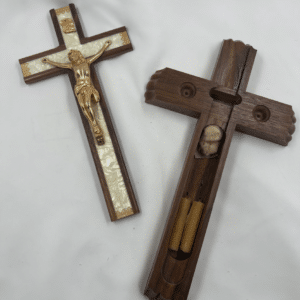
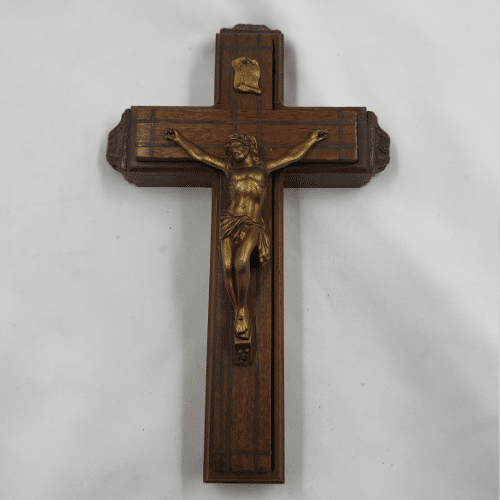
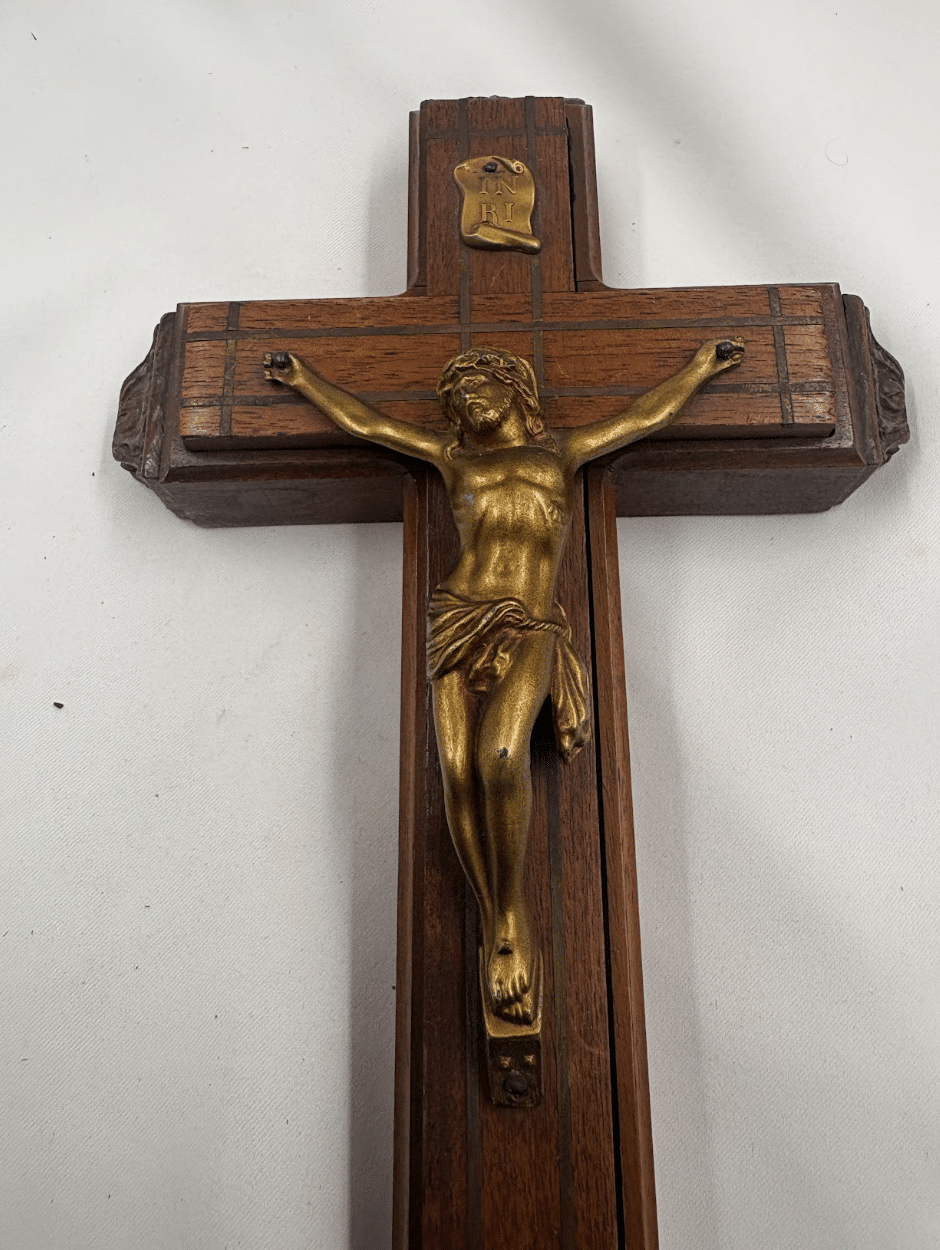
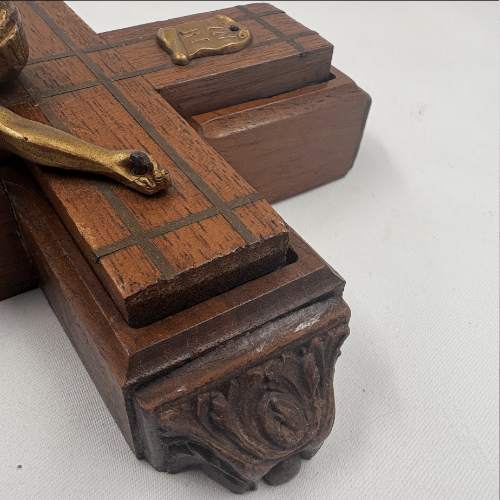
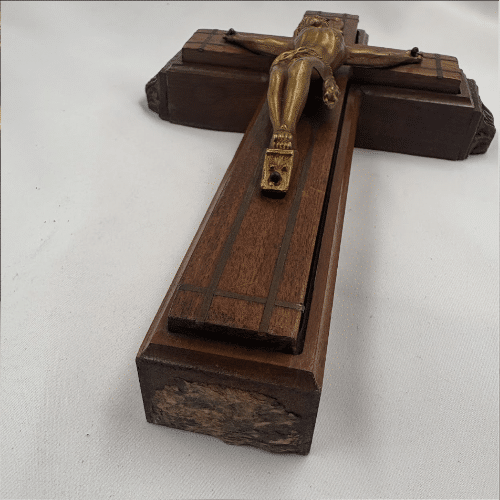
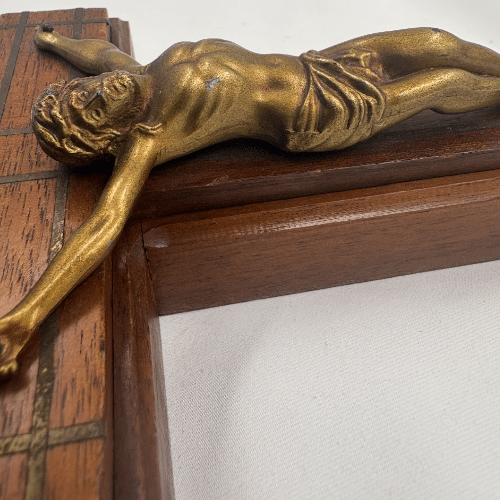
There are crucifixes that decorate a wall, and there are crucifixes made to be taken down when a priest came to the door. This handsome vintage Catholic Sick Call Crucifix, dating approximately to the 1960s, belongs to that deeply rooted tradition of Catholic household devotion. Crafted from richly toned hardwood with elegant brass line inlay, carved architectural ends, and a cast brass corpus of Christ, it was designed not merely as a visible expression of faith but as a practical part of the Catholic family’s preparation for the sacraments in times of serious illness.
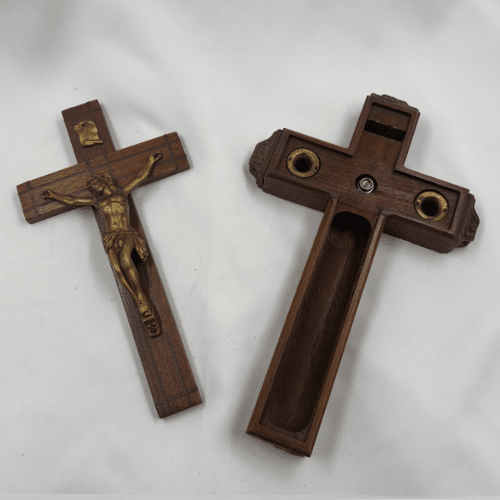
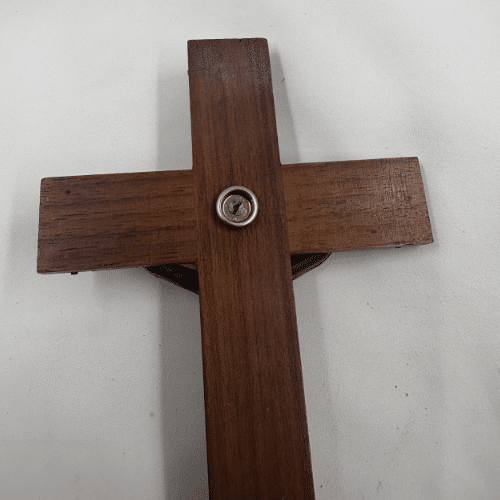
Its outward appearance is dignified and restrained. The warm hardwood is accented by narrow brass lines, while the carved ends lend the cross an architectural quality reminiscent of traditional Gothic church ornament. At its center rests the brass corpus of Christ beneath the original INRI plaque, the metal having acquired the warm patina that comes naturally with decades of age. Behind the crucifix lies its defining feature: a hidden Sick Call compartment. Such crucifixes were traditionally kept in Catholic homes so that necessary articles could be made ready when a priest was summoned to minister to someone who was gravely ill. The compartment could hold candles, holy water, and other devotional necessities used in preparing the bedside for the Sacrament of the Anointing of the Sick, the reception of Viaticum when appropriate, and the Church’s prayers for the sick and dying.
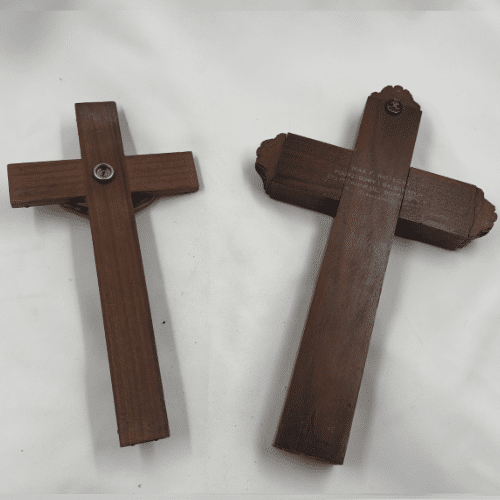
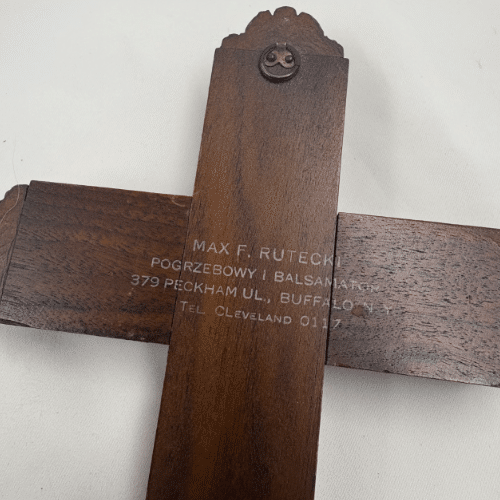
This particular crucifix carries another layer of history through its association with Max F. Rutecki, identified on the piece in connection with funeral and embalming services. That Polish-American association places the crucifix within the religious and cultural world of a Catholic immigrant community in the mid-twentieth century, giving it a historical identity that an anonymous Sick Call Crucifix cannot offer. Funeral establishments in Catholic communities occupied a distinctive place between parish and family life, serving households during precisely the circumstances for which a Sick Call Crucifix was created. The Rutecki association therefore gives this piece particular interest for collectors of Polish-American Catholic history, funeral memorabilia, Catholic devotional antiques, and twentieth-century religious artifacts.
The concealed compartment and its original fittings remain integral to the crucifix, although the original candles and holy water bottle are no longer present. These accessories were frequently consumed, discarded, or separated from Sick Call Sets over the decades, and their absence should be understood when considering the completeness of the artifact. Even without them, the crucifix retains the essential structure that tells its story: the cross, Christ Crucified, the hidden compartment, and the physical evidence of a Catholic household tradition centered upon preparation for the sacraments.
Today, it can be appreciated as both a devotional object and a tangible piece of Catholic social history. Displayed in a prayer room, Catholic home, rectory, chapel, or collection of religious antiques, it speaks quietly of a time when preparation for a priest’s arrival had a permanent place upon the household wall. The cross waited through ordinary days. And when illness came, it was ready to be opened.
Product Details
Item: Vintage Catholic Sick Call Crucifix / Last Rites Crucifix
Classification: Catholic Antiques → Sick Call Crucifixes
Period: Mid-Century
Estimated Date: c. 1960s
Associated Name: Max F. Rutecki
Historical Association: Polish-American funeral and embalming services
Material: Hardwood
Corpus: Cast brass with natural aged patina
Plaque: Original brass INRI plaque
Decorative Elements: Brass line inlay and carved architectural ends
Construction: Wall crucifix with sliding concealed sacramental compartment
Interior: Original compartment and fittings present
Missing Components: Original candles and holy water bottle
ACG Condition & Evaluation
ACG Grade: B — Cathedral Grade
Condition Score: 83/100
Overall Condition: Very Good Vintage Condition
Completeness: Incomplete; candles and holy water bottle absent
Collector Appeal: High
The hardwood cross remains structurally sound, with its carved ends, brass line decoration, original corpus, INRI plaque, and functioning sliding compartment intact. The brass displays an attractive natural patina appropriate to age.
The missing candles and holy water bottle reduce the completeness score and have been reflected in the 83/100 condition assessment. They do not, however, diminish the underlying quality of the crucifix or erase the historical interest provided by its identified Rutecki association. For these reasons, the piece retains its ACG B — Cathedral Grade classification.
A Collector’s Note
The appeal of this example lies less in accessory completeness than in the combination of traditional Sick Call construction, handsome brass and hardwood craftsmanship, and identified Polish-American funeral provenance. Most surviving Sick Call Crucifixes are anonymous household devotional objects; an example carrying an identifiable historical association offers another dimension for the collector.
For collectors of Catholic antiques, Sick Call Crucifixes, Last Rites Sets, Polish-American Catholic history, funeral-industry memorabilia, or vintage devotional objects, this crucifix preserves a meaningful intersection of faith, family, community, and the Catholic rites surrounding serious illness and death.
Vintage Catholic devotional objects may exhibit patina, surface wear, oxidation, and other evidence of age and previous use. Missing accessories are specifically identified above. Dates and historical attributions described as estimated or associated represent informed cataloging unless independently documented.