Shop Catholic Gifts
Shop by Sacrament
Shop by Devotion
Shop by Season
Shop Church Supplies
Missionary Expansion
The Great Commission and the Birth of Mission
 he story of Catholic missionary expansion begins not as a strategy, but as a command. At the close of His earthly ministry, Christ entrusted His followers with a universal mission: to carry the Gospel to all nations. This mandate—known as the Great Commission—transformed a small community in Jerusalem into a global movement that would span continents and centuries. At Pentecost, this mission ignited. The apostles, once fearful, emerged as bold heralds of a new faith. From Jerusalem, the message radiated outward through preaching, martyrdom, and witness. Within decades, Christian communities appeared across the Mediterranean world, from Antioch to Rome, from Alexandria to Asia Minor. Mission, in its earliest form, was not institutional but incarnational—carried by individuals who lived, suffered, and often died for the faith they proclaimed.
Apostolic Missions and the First Wave of Expansion (1st–3rd Century)
|
The first great missionary expansion unfolded under the shadow of the Roman Empire. Apostles and early disciples traveled along trade routes, urban centers, and cultural hubs, bringing the Gospel to Jews and Gentiles alike. Key characteristics of this period include:
|
|
|
By the early 4th century, Christianity had moved from a persecuted sect to a recognized—and eventually favored—religion within the empire. |
||
Monastic Missions and the Conversion of Europe (5th–10th Century)
With the collapse of the Western Roman Empire, missionary expansion took on a new form through monasticism. Monks became the primary agents of evangelization, carrying both the faith and the remnants of classical civilization into emerging European societies.
This era is marked by:
-
The Celtic Missions: Figures like Saint Patrick and Saint Columba brought Christianity to Ireland and Scotland, establishing monasteries that became centers of learning and evangelization.
-
The Anglo-Saxon Conversion: Missionaries such as Augustine of Canterbury reintroduced Christianity to England, blending Roman liturgical tradition with local culture.
-
The Benedictine Model: Monasteries followed structured rhythms of prayer, labor, and study, serving as hubs of spiritual and cultural renewal.
Missionary expansion during this period was deeply tied to the formation of European identity, embedding Christianity within the social and political fabric of emerging kingdoms.
Related products
-

Clip On Medal Saint Michael Qty of 4
$49.00BULK -

Saint Christopher Visor Clip – Catholic Home & Living
$14.00 -

Our Lady of Guadalupe Dangle Fabric Bracelet – Medals & Jewelry
$24.00 -

Wood Bead Epoxy Our Lady of Guadalupe Bracelet – Medals & Jewelry
$48.00 -

18″ 2mm Rope Chain – Medals & Jewelry
$72.00 -
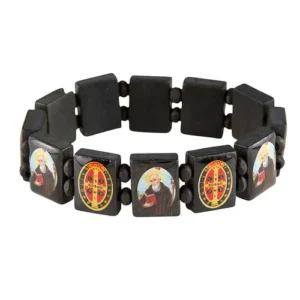
Black Wood Saint Benedict Bracelet with Image – Set of 12
$48.00BULK
Global Missions in the Age of Exploration (15th–17th Century)
The Age of Exploration marked a dramatic expansion of missionary activity beyond Europe. As maritime empires extended their reach, missionaries accompanied explorers, merchants, and settlers into the Americas, Africa, and Asia.
Distinctive features of this period include:
- The Rise of Missionary Orders: The Jesuits, Franciscans, Dominicans, and others developed organized, global missionary networks.
- Cultural Encounter and Dialogue: Missionaries like Matteo Ricci in China and Francis Xavier in Asia sought to engage local traditions with intellectual respect and adaptability.
- Tension and Complexity: Missionary efforts were often intertwined with colonial expansion, creating a legacy that includes both profound evangelization and ethical controversy.
Despite challenges, this era established Christianity as a truly global religion, with enduring communities across multiple continents.
Featured Catholic Blog Posts
 The Invitation: God’s Call to the Wedding Feast - The Invitation: God's Call to the Wedding Feast A Catholic Reflection on Matthew 22:1–14 Imagine receiving an invitation to a…
  The Seven Catholic Sacraments Explained: A Complete Guide - Learn the meaning of the seven Catholic sacraments: Baptism, Confirmation, Eucharist, Reconciliation, Anointing, Holy Orders, and Matrimony.
 Evangelization in the Modern World (18th–21st Century)
In the modern era, missionary expansion has evolved beyond territorial expansion into a deeper engagement with culture, justice, and human dignity.
Key developments include:
- Indigenous Leadership: Local clergy and laity now lead evangelization efforts within their own cultures, marking a shift from external to internal mission.
- Social and Humanitarian Mission: Education, healthcare, and charitable work have become integral expressions of the Church’s missionary identity.
- New Evangelization: In traditionally Christian regions experiencing secularization, the Church emphasizes renewal, re-evangelization, and personal encounter with faith.
Mission today is not confined to distant lands—it is understood as a universal calling, present in every culture and community.
Explore the Catholic Library
The Theology of Mission: A Universal Call
At its heart, missionary expansion is not merely historical—it is theological. The Church understands itself as missionary by nature, called to share the Gospel not as an imposition, but as an invitation to truth, beauty, and communion.
Core principles include:
- Inculturation: The Gospel takes root within cultures, elevating and transforming them without erasing their identity.
- Witness Before Words: Authentic Christian life—charity, humility, and holiness—remains the most persuasive form of evangelization.
- Universality: The mission is for all peoples, transcending language, geography, and time.
Legacy and Global Impact
Today, the Catholic Church is one of the most globally diverse institutions in history, with over a billion members across every continent. This global presence is the direct fruit of centuries of missionary expansion.
Its legacy includes:
- The preservation and transmission of knowledge through monastic and educational institutions
- The establishment of universities, hospitals, and charitable networks worldwide
- The integration of countless cultural traditions into a shared spiritual heritage
From the shores of Galilee to the farthest reaches of the modern world, the missionary journey continues—an unfolding story of faith carried across time, cultures, and civilizations.