The Edict of Cyrus: When God Opened the Road Home
In 539 BC, the armies of Cyrus the Great entered Babylon, bringing an end to the empire that had conquered Jerusalem and carried much of Judah’s population into exile. For the people who had spent decades far from their homeland, the fall of Babylon marked more than another change of rulers. It opened the possibility of returning to the land their ancestors had known, restoring their religious life, and rebuilding the Temple that once stood at the center of Jerusalem.
The man responsible for this remarkable change was not an Israelite prophet, a priest, or a descendant of David. He was a Persian king whose ambitions had carried him across much of the ancient Near East. Yet the Book of Ezra presents his decree as an instrument of God’s providence. Through the decisions of an earthly ruler, a displaced people received the opportunity to begin again.
The Edict of Cyrus stands among the most significant turning points in biblical history. It connects the destruction of Jerusalem with the restoration of Jewish worship, brings the words of the prophets into focus, and reveals a profound truth about God’s relationship with human history. Kings may command armies and govern nations, but their power does not place them beyond the reach of divine providence.
Before the Decree: The Fall of Jerusalem
To understand why Cyrus’s proclamation mattered, we must first return to the catastrophe that brought Judah’s people to Babylon. During the sixth century BC, the Babylonian Empire dominated the ancient Near East under King Nebuchadnezzar II. Jerusalem, the capital of the kingdom of Judah, stood in the path of Babylonian expansion. After years of rebellion and conflict, Babylonian forces destroyed the city and its Temple in 587/586 BC.
The destruction shattered the institutions that had shaped the people’s religious and national identity. The Temple built by Solomon had served as the center of sacrificial worship and a visible sign of God’s covenantal presence among His people. Now its sacred furnishings had been carried away, its walls lay in ruins, and members of Judah’s royal, priestly, and leading families lived in exile.
For those who endured this displacement, exile involved more than separation from familiar streets and fields. They faced the painful question of how to remain faithful to the Lord while living in a foreign land. The words of Psalm 137 capture that sorrow through the image of exiles sitting beside the rivers of Babylon and remembering Zion. Their grief reflected a longing for home, but it also expressed their attachment to Jerusalem as the place associated with God’s dwelling among His people.
Even in this suffering, the prophets proclaimed that judgment would not have the final word. Jeremiah spoke of a future restoration after Babylon’s appointed period of dominance, while Isaiah offered words of consolation to a people awaiting deliverance. These promises did not erase the reality of exile. Instead, they taught the people to look beyond their present circumstances and trust that God had not abandoned His covenant.
How Cyrus Rose to Power
While the exiles lived under Babylonian rule, a new power emerged farther east. Cyrus II, later remembered as Cyrus the Great, belonged to the Persian royal house that established the Achaemenid Empire. He began his rise as ruler of the Persians in the region of Anshan, within the broader Iranian world. From that relatively limited position, he gradually transformed his kingdom into one of the largest empires the ancient world had seen.
A decisive victory came around 550 BC, when Cyrus defeated Astyages, king of the Medes. This conquest gave him control over a much larger political and military sphere. He then extended Persian power westward, overcoming the wealthy kingdom of Lydia in Anatolia, traditionally dated to around 547/546 BC. These campaigns brought territories, resources, and important trade routes under Persian control.
By the time Cyrus turned toward Babylon, he commanded a formidable empire. Babylon itself remained a prestigious city, celebrated for its monumental architecture, religious institutions, and long history of political influence. Its king, Nabonidus, had become associated with religious controversies involving the city’s traditional cults. Cyrus’s victory in 539 BC therefore brought not only a military conquest but also a new approach to legitimizing royal authority.
Persian rule did not abolish the political realities of empire. Cyrus governed conquered territories through imperial institutions and expected loyalty from their inhabitants. Yet he also pursued policies that could strengthen his authority by restoring local sanctuaries and recognizing established religious traditions. This approach helped explain why his reign proved so consequential for the exiles from Judah.
The Proclamation That Changed Judah’s Future
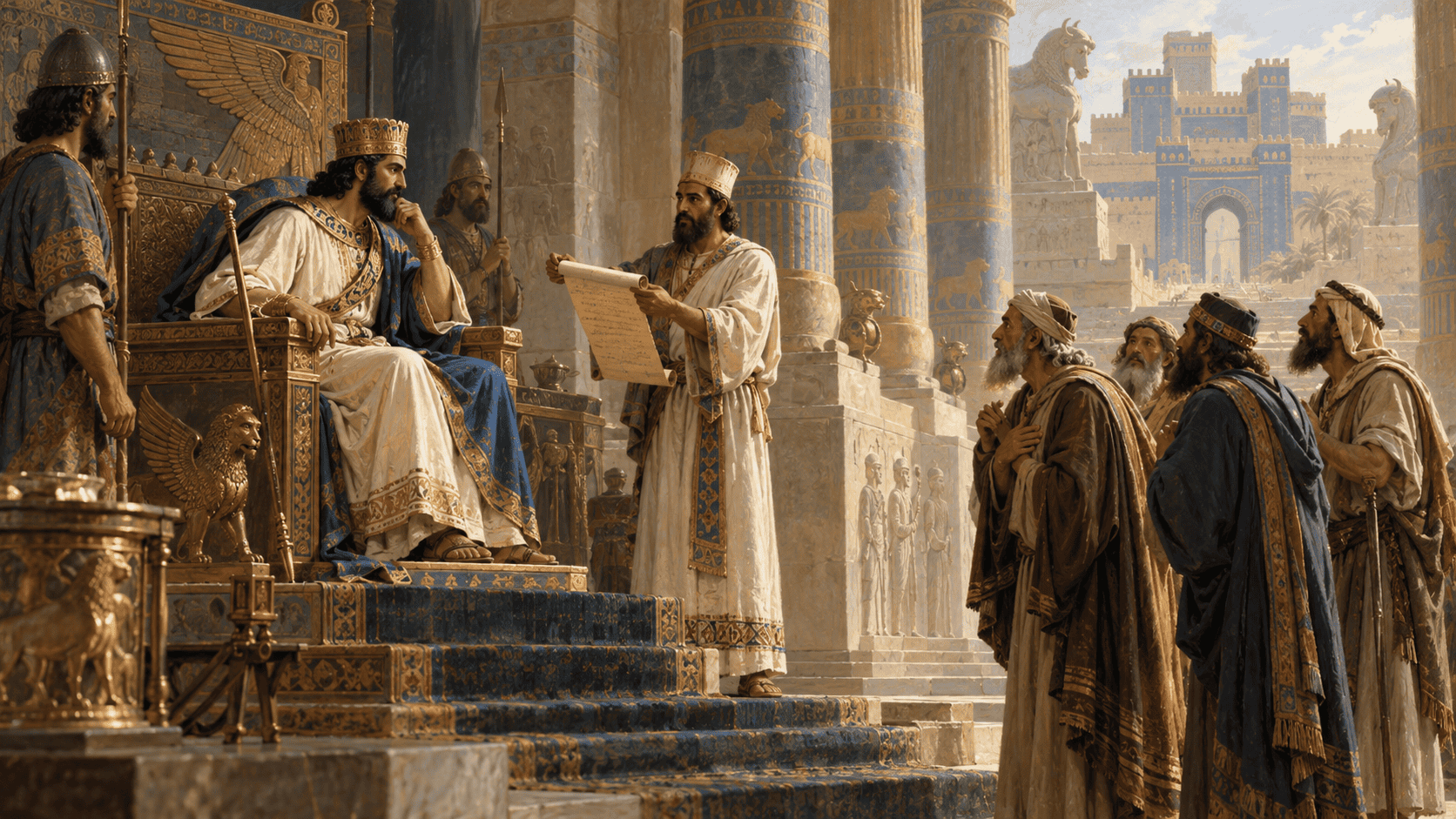
The Book of Ezra opens with an announcement that transforms the story of exile into a story of return. In the first year of Cyrus’s rule over Babylon, traditionally dated to 538 BC, the Persian king issued a proclamation allowing members of the Jewish community to go to Jerusalem and rebuild the house of the Lord.
Ezra 1:1–4 presents the decree as the fulfillment of God’s word spoken through Jeremiah. The biblical writer emphasizes that the Lord stirred Cyrus to act, placing the king’s political decision within a larger account of divine providence. The decree invited those who wished to return to Jerusalem and encouraged others to support the rebuilding effort with material assistance.
This permission mattered because the returnees were not simply resettling abandoned homes. They were undertaking the restoration of a religious community whose central sanctuary had been destroyed. Rebuilding the Temple meant recovering the public worship that had shaped Israel’s covenantal life. The decree therefore opened a path toward renewed communal identity, even though Judah would remain under Persian imperial authority.
Ezra also records that Cyrus ordered the return of sacred vessels that Nebuchadnezzar had taken from the Jerusalem Temple. These objects connected the restoration with the worship that had existed before the destruction. Their return carried symbolic weight: what had been removed during conquest could now serve the worship of the Lord once again.
Not every exile returned, and the journey did not immediately resolve the community’s difficulties. Families had established lives in Babylon, while Jerusalem remained a damaged city facing substantial practical challenges. Those who returned would need to rebuild homes, organize worship, and confront opposition. Nevertheless, the decree created an opportunity that had seemed almost unimaginable during the darkest years of exile.
The Cyrus Cylinder: What Archaeology Reveals
The biblical account gains historical context from one of the ancient world’s most famous surviving inscriptions: the Cyrus Cylinder. Discovered in Babylon in 1879 and now held by the British Museum, this clay object bears a text written in Babylonian cuneiform following Cyrus’s conquest of the city.
The inscription describes Cyrus’s arrival in Babylon, presents him as a legitimate ruler favored by the Babylonian god Marduk, and records his restoration of religious sanctuaries and displaced cult images. It also refers to the return of certain deported populations. These claims served the political purposes of a victorious king, who sought to present his rule as beneficial and divinely sanctioned according to Babylonian religious expectations.
The Cyrus Cylinder does not mention Jerusalem, the Jewish exiles, or the decree preserved in Ezra. It should not be described as the actual text of the biblical proclamation. Nevertheless, its account of religious restoration and the return of displaced communities provides important evidence for the broader policies associated with Cyrus’s reign.
That distinction strengthens rather than weakens a responsible reading of biblical history. Archaeology helps us understand the political world in which the events described by Scripture took place, while the biblical authors explain those events from the perspective of Israel’s covenant with God. The two sources do not tell an identical story, nor were they written for the same purpose. Read carefully, however, they illuminate different dimensions of a remarkable historical transition.
The Cylinder has sometimes been celebrated as the world’s first charter of human rights. Such a description applies a modern concept to an ancient royal inscription and can obscure its original political setting. Cyrus remained an imperial monarch, not a modern constitutional ruler. His policies nevertheless represented a significant change for communities that had suffered displacement under earlier empires.
Why Isaiah Calls Cyrus God’s Anointed
One of the most striking biblical passages concerning Cyrus appears in Isaiah 45. There, the Lord addresses the Persian king as His anointed, using a term closely associated with consecrated kingship in Israel. The passage presents Cyrus as an instrument through whom God will overcome obstacles and accomplish His purposes.
This language is remarkable because Cyrus did not belong to the covenant people of Israel. He ruled a foreign empire and operated within the religious and political world of ancient Persia. Yet Isaiah portrays the Lord as sovereign over nations beyond Israel’s borders, capable of directing events through rulers who do not fully know Him.
The designation does not make Cyrus the Messiah in the Christian understanding of that title. Nor does it imply that every action of the Persian king received divine approval. Rather, it identifies a particular role within God’s providential plan: Cyrus would help bring about the liberation and restoration of the exiles.
The passage challenges the assumption that God works only through people who recognize His authority. Throughout Scripture, the Lord acts within complicated political circumstances and through imperfect human agents. Their motives may differ from His purposes, yet their decisions can still become part of a larger history of salvation.
For Catholic readers, this distinction invites both humility and hope. We should not confuse worldly success with holiness or imagine that political power automatically reveals God’s favor. At the same time, we need not believe that the course of history rests entirely in the hands of rulers. The God who called Israel into covenant remains Lord over the nations and can bring good from circumstances that human beings scarcely understand.
The Long Road from Exile to Restoration
Cyrus’s decree opened the road home, but the restoration of Jerusalem unfolded over many years. The returning community faced the difficult work of rebuilding its religious and social life. The books of Ezra and Nehemiah preserve memories of this process, including efforts to restore worship, rebuild the Temple, and renew the people’s commitment to the Law.
The Second Temple eventually reached completion in 515 BC, during the reign of the Persian king Darius I. Its dedication marked an important milestone in the restoration of Jewish worship, although the community’s political circumstances remained far different from those of the earlier Davidic kingdom.
The return from exile therefore combined fulfillment with continued expectation. God’s people had returned to the land and rebuilt the sanctuary, but they still awaited the fullness of the promises proclaimed by the prophets. Their history continued through periods of foreign domination, religious renewal, and longing for deliverance.
Within the Christian reading of salvation history, this expectation prepares the way for Jesus Christ. The restoration of the Temple belongs to the long story through which God preserved His people and prepared the world for the coming of the Savior. The return from Babylon was a genuine historical deliverance, but it was not the final liberation from sin and death that Christians recognize in Christ’s Passion and Resurrection.
From Cyrus to Caesar: Who Holds Ultimate Authority?
Centuries after Cyrus issued his decree, another empire governed the land of Israel. Roman authority shaped daily life in Judea, and questions about loyalty, taxation, and political power surrounded the ministry of Jesus. In Matthew 22:15–22, His opponents attempted to trap Him by asking whether it was lawful to pay the imperial tax to Caesar.
Jesus asked to see the coin used for the tax and directed attention to the emperor’s image and inscription. His response acknowledged the legitimacy of appropriate civic obligations while making clear that those obligations did not exhaust what human beings owe. Earthly rulers may exercise genuine authority, but God holds a claim upon the whole person that no government can replace.
The connection with Cyrus is not that Jesus was directly commenting on the Persian decree. The two passages arise from different historical circumstances and address different immediate questions. Their deeper relationship emerges through the biblical understanding of political authority under God’s sovereignty.
Cyrus’s decree demonstrates how God can work through the decisions of an earthly ruler to advance His purposes. Jesus’ teaching about Caesar clarifies the limits of earthly claims upon human loyalty. Together, these passages remind us that political power can shape events, create obligations, and influence the lives of nations, yet it never becomes the ultimate source of truth, justice, or human dignity.
The Catechism of the Catholic Church teaches that legitimate civil authority serves the common good and deserves appropriate respect, while also recognizing that citizens must not obey commands contrary to the moral order. Christians therefore approach public life neither with contempt for government nor with unquestioning allegiance to it. They fulfill just obligations while remembering that conscience remains accountable to God.
This distinction offers a lasting lesson from the Edict of Cyrus. A ruler may open a road, authorize a building, or change the destiny of a community. Such decisions matter enormously. Yet the deepest direction of human life comes from the Lord, whose authority reaches beyond every throne and empire.
What the Edict of Cyrus Teaches Us Today
Most Catholics will never experience an exile like the one endured by Judah’s people, yet the spiritual themes of this history remain familiar. Families know what it means to wait for circumstances to change. Communities struggle to rebuild after loss. Individuals may spend years praying for reconciliation, healing, or a new beginning without knowing when the opportunity will come.
The return from Babylon reminds us that hope is not simply optimism about immediate results. The exiles endured a long period of displacement before political circumstances changed. Even after Cyrus’s decree, the restoration demanded patience, sacrifice, and sustained work. God’s providence did not eliminate human responsibility; it opened a path along which His people still had to travel.
We can recognize a similar pattern in our own lives. A difficult relationship may begin to heal through an unexpected conversation. A parish may find new opportunities after years of uncertainty. Someone who has drifted from prayer may discover a renewed desire for God through an ordinary encounter or a moment of reflection. These experiences do not allow us to identify every event as a direct divine intervention, but they can encourage us to remain attentive to grace.
The story also teaches us to avoid narrowing God’s possibilities to the people and circumstances we already understand. Cyrus was an unlikely figure in Israel’s story of restoration, yet Scripture remembers him for the opportunity his decree created. His example reminds us that God is not confined by our expectations, even as we remain responsible for judging human actions according to truth and justice.
Finally, the return to Jerusalem reveals the importance of worship in the life of God’s people. The exiles did not merely seek a change of address. They longed to restore their covenantal life and the worship that expressed their relationship with the Lord. For Catholics, that longing finds a particular resonance in the centrality of the Eucharist, through which Christ gathers His Church and nourishes her with His own life.
The King Who Opened the Gate
Cyrus the Great entered history as a conqueror who built an empire stretching across vast territories. The biblical tradition remembers him for something more particular: a decree that allowed Judah’s exiles to return and rebuild the Temple in Jerusalem. The king may have viewed the proclamation through the practical concerns of imperial government, but the Book of Ezra sees in it the fulfillment of God’s promise.
That contrast lies at the heart of the story. Human rulers act within the limits of their ambitions, knowledge, and authority. God works within history without becoming subject to those limits. His providence does not make every political decision righteous, nor does it remove human freedom. Instead, Scripture invites us to recognize that the Lord remains faithful even when the path toward restoration passes through unexpected hands.
Centuries later, Jesus would teach that Caesar must receive what properly belongs to Caesar, while God must receive what belongs to God. Cyrus’s decree had opened the road home for Judah’s exiles; Christ would reveal the deeper homecoming toward which salvation history moves. Earthly rulers may shape the circumstances of our lives, but God alone is the final end of our journey.
The Edict of Cyrus therefore offers more than a lesson in ancient politics. It invites us to trust the Lord of history, fulfill our responsibilities with integrity, and remain open to the possibilities of grace. The gates of Babylon once seemed to stand between an exiled people and their homeland. Then history changed, a road opened, and the long work of restoration began.
A Prayer for Trust in God’s Providence
Heavenly Father, Lord of all nations and generations, You remained faithful to Your people through the sorrow of exile and the joy of their return. Teach us to trust Your providence when the future seems uncertain and the way forward remains hidden.
Give wisdom to those who govern, courage to those who seek justice, and patience to those who wait for renewal. Help us fulfill our duties in this world without forgetting that our deepest loyalty belongs to You. Through Jesus Christ our Lord, guide us toward the heavenly home You have prepared for those who love You. Amen.
Sources and Further Reading
United States Conference of Catholic Bishops, Ezra 1. The biblical account of Cyrus’s proclamation and the return of the Temple vessels.
United States Conference of Catholic Bishops, Isaiah 45. The prophetic portrayal of Cyrus as an instrument of God’s purposes.
United States Conference of Catholic Bishops, Jeremiah 29. The prophetic promise of restoration after exile.
United States Conference of Catholic Bishops, Matthew 22. Jesus’ teaching concerning Caesar and the obligations owed to God.
The British Museum, The Cyrus Cylinder. The surviving Babylonian royal inscription and its historical interpretation.
The Metropolitan Museum of Art, The Cyrus Cylinder and Ancient Persia. Historical background on Persian imperial rule and the restoration of displaced communities.
Catechism of the Catholic Church, especially paragraphs 1897–1904 and 2234–2243, on political authority, the common good, and the duties of citizens.