Saint Teresa of Ávila and the Courage of Interior Prayer
In sixteenth-century Spain, Teresa of Ávila discovered that prayer demanded more than good intentions. She knew the difficulty of concentrating, the pull of conversation and daily duties, and the discouragement that follows when a person longs for God but struggles to remain attentive. Those experiences did not disqualify her from holiness. They helped her speak to generations of Christians who know that friendship with Christ develops through perseverance rather than perfect feelings.
Teresa’s candor remains one of the most appealing qualities of her spiritual writing. She neither hid her weaknesses nor allowed them to define her. Instead, she returned to prayer and learned to trust the Lord who called her to deeper friendship.
Faith Tested by Ordinary Difficulties
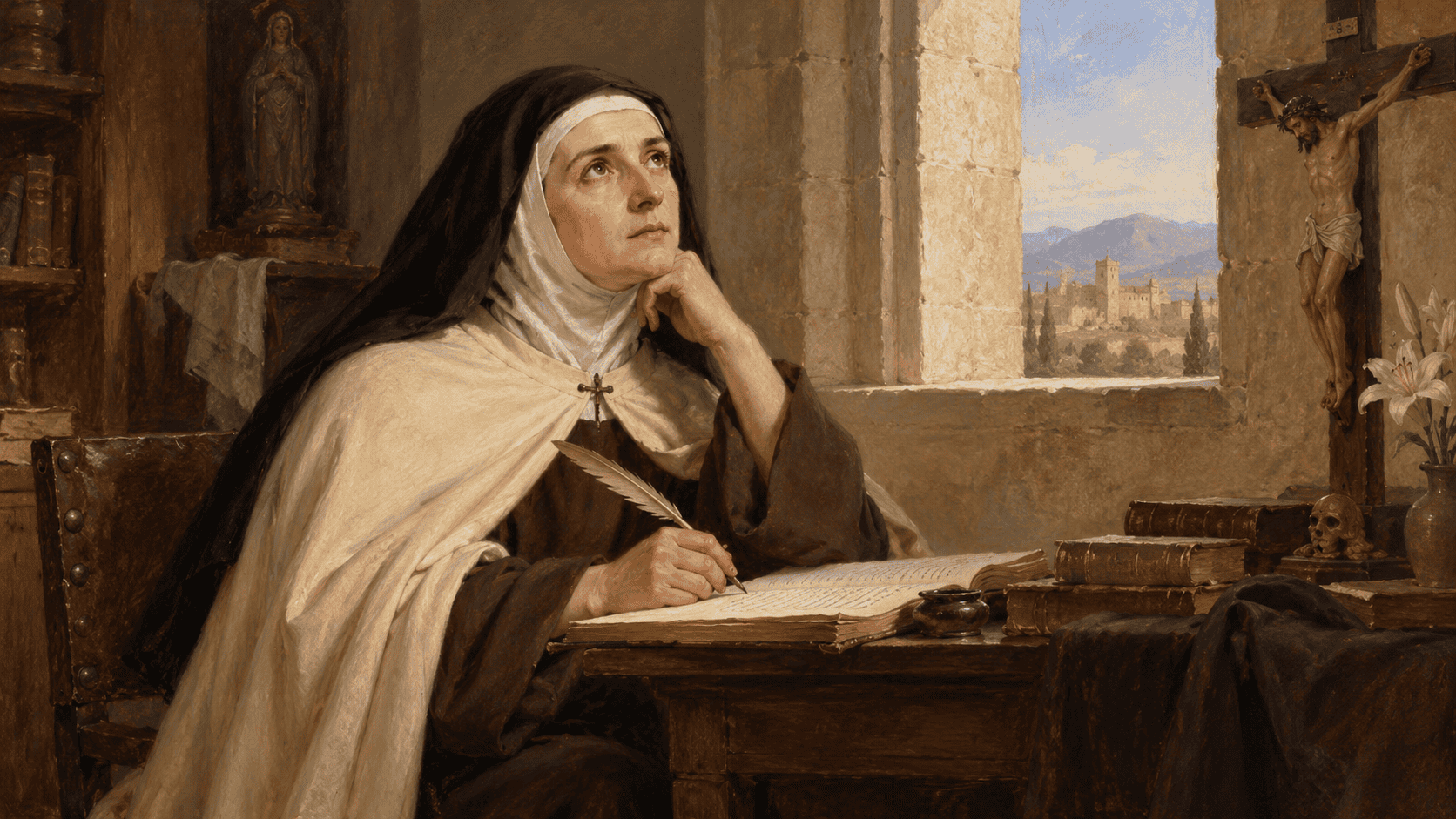
Born in 1515, Teresa entered the Carmelite convent of the Incarnation in Ávila in 1535 and made her religious profession in 1537. Illness and periods of spiritual struggle marked her early religious life. She later described how distractions and competing attachments weakened her commitment to mental prayer. Her account matters because it shows spiritual growth as a genuine struggle, not an uninterrupted series of consolations.
As Teresa grew in prayer, she also recognized the need to renew Carmelite life. She pursued a reform centered on simplicity, poverty, community, and contemplation. The work brought opposition and exhausting practical challenges, yet she persisted. Her life reminds us that authentic contemplation does not eliminate responsibility; it can give a person the courage to meet it.
Prayer as Friendship with Christ
In The Book of Her Life, chapter 8, Teresa describes mental prayer through the language of friendship, emphasizing time spent with the God who loves us. The Catechism of the Catholic Church, paragraph 2709, draws on this teaching when explaining contemplative prayer. Teresa did not ask ordinary Christians to master elaborate techniques before approaching Christ. She encouraged them to come with honesty and to remain with Him.
That invitation can feel surprisingly difficult. We may expect prayer to produce immediate calm, then mistake distraction for failure. Teresa knew that attention must be learned. Friendship grows when we return, listen, and make time for the other person even when conversation feels awkward. The same patient fidelity shapes our relationship with Christ.
The Interior Castle and the Life Within
Teresa developed another enduring image in The Interior Castle, written in 1577. She pictured the soul as a castle with many dwelling places, drawing the reader toward a deeper awareness of God’s presence. The image gives shape to a journey that includes self-knowledge, humility, conversion, and an increasing surrender to grace.
Although Teresa received extraordinary mystical graces, she did not make unusual experiences the measure of holiness. Humility and love mattered more. A person who prays faithfully should become more attentive to the needs of others, not more absorbed in private spiritual accomplishments. This connection between contemplation and charity keeps her teaching firmly rooted in the Gospel.
Perseverance When Prayer Feels Dry
Teresa understood how easily discouragement enters the spiritual life. Some days prayer brings consolation; on others, the mind wanders and the heart feels distant. She urged believers not to abandon the practice simply because it had become difficult. God’s love does not disappear when our emotions change.
For a parent, worker, student, or caregiver, that perseverance may begin with a few quiet minutes. Reading a Gospel passage, speaking candidly to Christ, or sitting silently before a crucifix can establish a rhythm of attention. The goal is not to imitate a convent’s schedule but to make room for the Lord within the responsibilities of one’s vocation.
A Teacher for the Whole Church
Teresa helped establish the Discalced Carmelite reform and worked alongside Saint John of the Cross. Her writings, including The Book of Her Life, The Way of Perfection, and The Interior Castle, continue to guide readers in prayer. She died in 1582, was canonized in 1622, and was declared a Doctor of the Church by Pope Saint Paul VI in 1970. The Church celebrates her feast on October 15.
Her influence reaches well beyond Carmelite communities. Teresa shows that a person can love silence without neglecting action, seek holiness without pretending to be flawless, and meet opposition without losing the habit of prayer. Her courage grew from the friendship she cultivated with Christ.
Learning from Teresa Today
Begin with a manageable daily appointment for prayer. Set aside distractions, read a short passage from the Gospels, and speak to Christ as someone who knows and loves you. If the time feels unproductive, return the next day. Consistency can teach us to receive God’s grace without demanding a particular emotional reward.
A simple prayer corner, crucifix, or Catholic Bible may help establish that habit. Such objects do not replace prayer; they remind us to make space for it. Readers may also find practical encouragement in Catholic Living: How to Live Your Faith Every Day.
A Closing Reflection
Teresa did not become a great teacher because prayer always came easily. She learned to return to Christ through illness, distraction, reform, and uncertainty. Her witness invites us to do the same. We need not wait for perfect silence or an extraordinary spiritual experience. We can begin with a willing heart and trust that friendship with Christ will deepen as we faithfully return to Him.
A Prayer Inspired by Saint Teresa of Ávila
Lord Jesus Christ, teach us to seek You with honesty and patience. When distractions trouble our prayer, help us return to Your presence. Through the intercession of Saint Teresa, deepen our trust, strengthen our love for the Church, and lead us to serve others with humility. Amen.
Sources and Further Reading
Saint Teresa of Ávila, The Book of Her Life, chapter 8; The Interior Castle; Catechism of the Catholic Church, §§2709–2719; Pope Benedict XVI, General Audience, February 2, 2011; Pope Paul VI, Multiformis Sapientia Dei (1970).