All Souls: Praying for the Faithful Departed
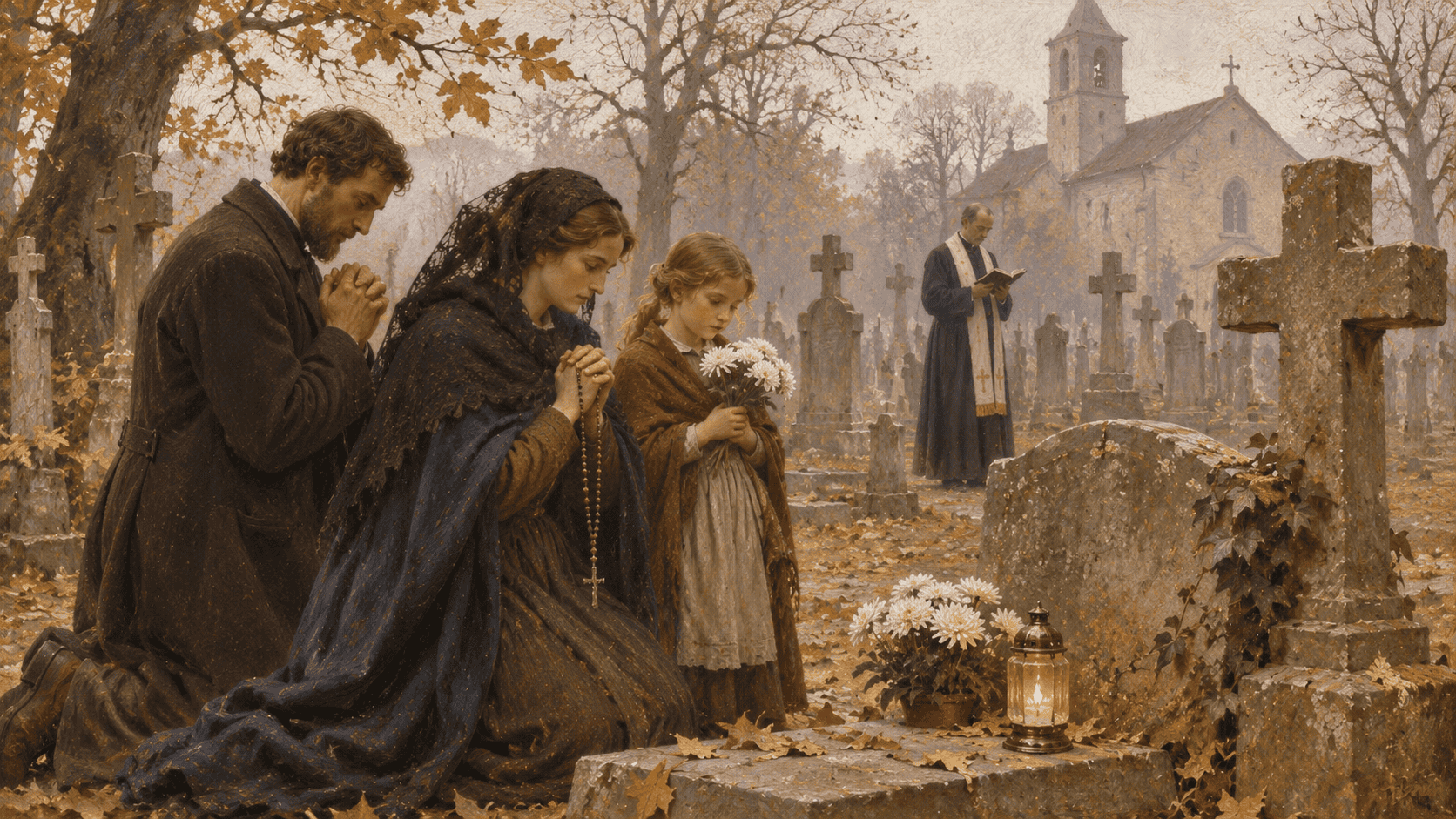
On a quiet November morning, a Catholic cemetery can become a place of extraordinary tenderness. Families walk slowly between rows of headstones, carrying flowers, candles, and memories of those whose voices once filled their homes. Some pause before the graves of parents or grandparents. Others remember a spouse, a child, a sibling, or a friend whose absence still shapes the ordinary rhythm of life. Beneath the silence of the cemetery lies something greater than remembrance alone: the conviction that love does not end at death.
Each November 2, the Catholic Church observes the Commemoration of All the Faithful Departed, commonly known as All Souls’ Day. On this solemn occasion, Catholics throughout the world pray for those who have died, especially the souls undergoing purification before entering the fullness of heaven. Through the celebration of Mass, prayers for the dead, visits to cemeteries, and acts of charity, the Church expresses her enduring concern for those who have gone before us.
All Souls’ Day is not simply a religious memorial or a day devoted to mourning. It is a profound expression of Catholic teaching about death, judgment, purgatory, the communion of saints, and the resurrection of the body. The Church remembers the departed because she believes that Christ’s victory over death reaches beyond the boundaries of earthly life.
For Catholics, praying for the faithful departed is therefore both an act of love and a profession of hope. We entrust those who have died to the mercy of God, confident that the risen Christ remains the source of eternal life.
What Is All Souls’ Day in the Catholic Church?
All Souls’ Day is the annual commemoration on November 2 during which the Catholic Church prays for all the faithful departed. Although Catholics remember the dead throughout the year, this particular day gives special prominence to the Church’s prayer for those who have died in Christ and may still need purification before entering heaven.
The commemoration follows the Solemnity of All Saints on November 1. The placement of these observances is deeply meaningful. All Saints’ Day celebrates those who already share in the glory of heaven, including the countless holy men and women whose names are known only to God. All Souls’ Day turns our attention toward the faithful departed for whom the Church continues to offer her prayers.
These two observances reveal different dimensions of the same Christian hope. The saints in heaven have reached the fulfillment of their earthly pilgrimage, while the faithful departed undergoing purification are being prepared for the complete joy of God’s presence. The Church on earth remains united with them through Christ, whose saving work embraces the whole communion of believers.
Unlike a canonized saint’s feast, All Souls’ Day is not primarily a celebration of particular individuals whose heavenly glory the Church publicly recognizes. Instead, it is a day of intercession. We ask God to forgive the sins of the departed, complete their purification, and welcome them into eternal peace.
This distinction also explains why Catholics do not presume to know the eternal state of every person who has died. Rather than attempting to judge another soul, the Church responds with prayer, entrusting the departed to the perfect justice and infinite mercy of God.
Why Do Catholics Pray for the Dead?
For many people, the idea of praying for someone who has already died raises an understandable question. If earthly life has ended, what purpose can prayer still serve?
The Catholic answer begins with the conviction that death does not destroy the spiritual communion established through Christ. Those who belong to Him are not separated from His love by the grave. The Church therefore continues to pray for her departed members, asking that they receive the fullness of the salvation Christ has won.
The Catechism of the Catholic Church, paragraph 1032, explains that the Church has honored the memory of the dead from her earliest centuries and has offered prayers for them, especially the Eucharistic sacrifice. These prayers are connected to the Catholic understanding of purification after death, traditionally called purgatory.
Praying for the dead does not imply that Christ’s sacrifice was insufficient. On the contrary, the Church’s intercession depends entirely upon His saving work. Every grace of forgiveness and purification comes through Jesus Christ, whose Death and Resurrection opened the way to eternal life.
Our prayers are therefore neither attempts to change God’s character nor efforts to purchase salvation for another person. They are acts of Christian charity through which we commend the departed to the mercy of the Lord.
When we pray for someone who has died, we acknowledge that our love remains meaningful even when we can no longer speak with that person, offer practical assistance, or share the ordinary experiences of earthly life. Prayer becomes a way of continuing to love within the communion of Christ’s Church.
The Biblical Foundations of Prayer for the Dead
Catholic teaching on prayer for the dead draws upon Sacred Scripture, the Church’s living Tradition, and her understanding of the communion of saints. One of the clearest biblical passages appears in the Second Book of Maccabees.
In 2 Maccabees 12:38–46, Judas Maccabeus arranges for an offering to be made on behalf of fallen soldiers. The passage connects this action with belief in the resurrection and describes prayer for the dead as a holy and pious practice. For Catholics, who receive 2 Maccabees as part of the inspired canon of Scripture, this account provides important testimony to the ancient practice of interceding for the departed.
The New Testament deepens Christian hope through its proclamation of Christ’s victory over death. In John 11:25–26, Jesus identifies Himself as the resurrection and the life during His encounter with Martha following the death of her brother Lazarus. His words direct human grief toward the promise of life in Him.
Saint Paul likewise teaches in 1 Corinthians 15 that Christ’s Resurrection is the foundation of the Christian hope of resurrection. Death is a real enemy, but it does not possess the final victory. Through Christ, the faithful await the resurrection of the body and the fulfillment of God’s saving plan.
These passages do not all address prayer for the dead in the same way. The account in Maccabees explicitly describes intercession for the departed, while the New Testament passages establish the resurrection-centered hope within which the Church offers that intercession. Together with apostolic Tradition, they help explain why Catholics continue to pray for those who have died.
Understanding Purgatory: God’s Mercy and Final Purification
Few Catholic teachings are as frequently misunderstood as purgatory. Some imagine it as a second opportunity for salvation, while others picture it as a destination completely separate from God’s love. Neither understanding accurately expresses the Church’s teaching.
The Catechism, paragraphs 1030–1031, teaches that those who die in God’s grace and friendship but remain imperfectly purified undergo a final purification before entering the joy of heaven. Their eternal salvation is assured; what remains is the purification necessary for complete holiness.
Purgatory is therefore not a second chance to choose God after death. Nor is it a lesser form of damnation. It concerns those who belong to Christ and are being prepared to enjoy the fullness of communion with Him.
To understand the need for purification, we must recognize that salvation involves more than the removal of guilt. Sin can leave attachments, habits, and disorders within the human heart. God’s saving grace does not merely declare us forgiven; it transforms us so that we may love Him without the limitations that have marked our earthly lives.
The Book of Revelation describes the heavenly Jerusalem as a place into which nothing unclean shall enter (Revelation 21:27). The Church’s teaching on final purification reflects this conviction that the fullness of heaven requires complete holiness.
Catholics should nevertheless approach the mystery with humility. The Church teaches the reality of purification after death, but she does not provide a detailed physical description of its experience or a measurable timetable for its duration. Popular images of purgatory may serve devotional purposes, yet they should not be mistaken for definitive descriptions of the afterlife.
On All Souls’ Day, the Church directs our attention away from speculation and toward what matters most: prayer, mercy, and confidence in the saving power of Christ.
The Communion of Saints: A Love Stronger Than Death
Every Sunday, Catholics profess belief in the communion of saints through the Apostles’ Creed. This article of faith expresses the profound spiritual unity of those who belong to Christ.
The Church traditionally speaks of the faithful on earth, the souls undergoing purification, and the blessed in heaven as united within the one Body of Christ. Although their conditions differ, they are not separate communities without relationship to one another.
The Catechism, paragraphs 954–959, explains this communion and the spiritual solidarity that exists among Christ’s members. Those in heaven intercede for the faithful on earth, while the Church continues to assist the departed through her prayers.
This teaching gives All Souls’ Day its distinctive tenderness. We do not remember our loved ones merely as figures belonging to the past. We entrust them to God while recognizing that the bonds of Christian charity endure within Christ.
The communion of saints also connects All Souls’ Day with the preceding celebration of All Saints. On November 1, the Church rejoices in those who have reached heavenly glory. On November 2, she prays for the departed who still await the completion of their purification.
Both days remind us that the Christian journey leads beyond the limits of earthly life and finds its fulfillment in union with God.
How All Souls’ Day Became a Churchwide Tradition
Christian concern for the departed reaches back to the earliest centuries of the Church. Ancient Christian communities remembered the dead in prayer and celebrated the Eucharist with the conviction that Christ’s saving sacrifice united the living and the departed.
Saint Augustine provides an especially moving witness to this tradition in his Confessions. Near the end of Book IX, he recalls the death of his mother, Saint Monica, and offers prayer for her. The account reveals how deeply the practice of intercession for the dead had entered Christian life by the late fourth century.
Over time, monasteries and local churches developed particular days devoted to remembering the faithful departed. A significant development occurred around the end of the tenth century, when Saint Odilo, abbot of the Benedictine monastery of Cluny, promoted a commemoration of the departed on November 2 within the Cluniac monastic network.
The observance subsequently spread beyond Cluny and became established more broadly in the Western Church. Although the historical development involved several stages, Saint Odilo’s initiative played an important role in the emergence of the November 2 commemoration familiar to Catholics today.
The tradition expresses a remarkably consistent Christian conviction across centuries: the faithful should remember those who have died, offer prayers for them, and place their hope in the mercy of God.
Why the Mass Is the Most Important Prayer for the Departed
Among the many devotions associated with All Souls’ Day, the celebration of the Eucharist holds a unique place. The Mass is the Church’s supreme act of worship, making sacramentally present the one sacrifice of Jesus Christ.
Because the Church’s prayer for the departed depends upon Christ’s saving work, the Eucharistic sacrifice possesses particular importance. The Catechism explicitly identifies the Eucharist as central to the Church’s intercession for the dead.
At every Mass, the Church remembers those who have died. During the Eucharistic Prayer, she asks God to receive the departed into His peace and to grant them a share in the resurrection. These petitions remind the faithful that prayer for the dead is not restricted to a single day in November.
On All Souls’ Day, Catholics may attend Mass specifically to pray for deceased family members, friends, and all the faithful departed. They may also request that a Mass be offered for a particular person, according to the practices of their parish.
Offering a Mass intention is not a purchase of divine favor. Any customary stipend supports the Church and her ministers; the spiritual value of the Mass comes from Christ’s sacrifice, not from a monetary payment.
For families grieving a recent loss, attending Mass can be a particularly meaningful act of remembrance. Within the Church’s worship, personal sorrow is joined to the prayer of the whole Christian community and entrusted to the risen Lord.
Visiting a Cemetery on All Souls’ Day
One of the most recognizable Catholic customs associated with November 2 is visiting the graves of deceased loved ones. Families may bring flowers, clean headstones, pray the Our Father, or spend a few moments in silence remembering those who have died.
A cemetery visit expresses respect for the human body and the Church’s belief in the resurrection of the dead. Catholic faith does not regard the body as a disposable shell. The human person is a unity of body and soul, and the resurrection promised by Christ includes the final glorification of the body.
For this reason, Catholic burial traditions treat the remains of the deceased with dignity. The Catechism, paragraph 2300, teaches that the bodies of the dead must be treated with respect and charity in faith and hope of the Resurrection.
Visiting a cemetery can also provide an opportunity to teach children about Christian hope. Rather than avoiding every conversation about death, parents can explain that grief is a natural expression of love and that Catholics pray for the departed because they trust in God’s mercy.
Families who cannot visit a grave may still participate in the spirit of All Souls’ Day by praying at home, attending Mass, or remembering the deceased before a crucifix or sacred image.
Indulgences and Prayer for the Faithful Departed
The Church also encourages the faithful to pray for the departed through practices associated with indulgences. Because this subject is often misunderstood, it deserves careful explanation.
An indulgence is the remission before God of temporal punishment due to sins whose guilt has already been forgiven, obtained through the Church’s ministry under the conditions she establishes. Indulgences do not forgive the guilt of sin, replace repentance, or guarantee salvation through the performance of an external act.
The Church teaches that the faithful may apply indulgences to the departed by way of suffrage. In particular, established indulgenced practices include devout visits to cemeteries during November 1–8, with prayer for the departed, and a visit to a church or oratory on All Souls’ Day under the prescribed conditions.
A plenary indulgence ordinarily requires sacramental confession, reception of Holy Communion, prayer for the intentions of the Roman Pontiff, and complete detachment from sin, even venial sin, together with the indulgenced work. When the necessary dispositions or conditions are lacking, the indulgence may be partial.
Because indulgence norms and special concessions can be subject to official clarification, Catholics should consult current diocesan guidance or the Church’s Manual of Indulgences before relying upon specific instructions.
The purpose of these practices is not to encourage a mechanical understanding of grace. Rather, they unite prayer for the departed with repentance, sacramental life, and the spiritual treasury of the Church.
How Catholic Families Can Observe All Souls’ Day at Home
Although participation in Mass is the most important liturgical expression of All Souls’ Day, the commemoration can also shape family prayer and remembrance at home.
Some families place photographs of deceased relatives near a crucifix or prayer corner. Others light a devotional candle while praying for loved ones, carefully observing ordinary fire safety. A family might read the names of deceased relatives aloud and offer a short prayer for each person.
The Rosary provides another meaningful form of intercession. Families may offer a decade or an entire Rosary for the faithful departed, meditating especially upon the glorious mysteries and the promise of resurrection.
Children can participate through simple acts of remembrance. They may help arrange flowers, write the names of departed relatives in a family prayer book, or listen to stories about the lives of grandparents and other loved ones. These practices preserve family memory while placing that memory within the hope of Christian faith.
A household might also perform a work of mercy in memory of someone who has died. Providing food to a family in need, visiting a lonely neighbor, or making a charitable contribution can honor the deceased while extending Christian love to the living.
For readers seeking guidance on incorporating devotional practices into family life, our guide to Catholic traditions, customs, and family devotions offers further ideas.
Prayer cards, rosaries, and devotional candles may support these customs. Such items are available through All Catholic Gifts, although the heart of the observance remains prayer rather than the objects themselves.
Remembering Those Who Have No One to Pray for Them
All Souls’ Day also invites Catholics to extend their concern beyond the members of their own families. Many people die without close relatives, while others are forgotten as generations pass and the details of their lives disappear from human memory.
The Church’s prayer embraces these souls as well. In praying for all the faithful departed, Catholics acknowledge a communion larger than personal relationships and family history.
This universal concern reflects the charity of Christ, who calls His disciples to love beyond the boundaries of familiarity. A person whose name we have never known is not forgotten by God, and our prayer can become an expression of solidarity with those whose earthly lives have ended.
When visiting a cemetery, we might pause before an unfamiliar grave and offer a prayer. At Mass, we can consciously include those who have no one to remember them. Such gestures remind us that Christian charity reaches beyond what we can see or personally understand.
Finding Hope When Grief Remains
For those who have recently lost someone they love, All Souls’ Day may awaken grief that remains painfully close. The Church does not ask the bereaved to pretend that death is insignificant or that faith removes the sorrow of separation.
Jesus Himself wept at the tomb of Lazarus. His tears reveal that grief is not contrary to faith. Even as He prepared to call Lazarus from the tomb, He entered the sorrow of those who mourned.
Christian hope does not eliminate grief; it places grief within the promise of resurrection. Catholics may mourn deeply while trusting that Christ has overcome death. We may miss the presence of someone we love while continuing to pray for that person’s eternal peace.
This is one reason All Souls’ Day remains so important. It gives the faithful a shared language of remembrance, sorrow, charity, and hope. No one must carry grief as though the departed have vanished from the Church’s concern.
Through the Eucharist and the prayers of the faithful, the Church continually entrusts the dead to God’s mercy. In doing so, she also consoles the living with the promise that the final word belongs not to death but to Jesus Christ.
All Souls’ Day and the Promise of Resurrection
The deepest meaning of All Souls’ Day rests upon the Resurrection of Christ. Without the Resurrection, remembrance would remain an act directed toward the past. Because Christ has risen, the Church looks toward a future in which death will be overcome and God’s saving work will reach its fulfillment.
Saint Paul describes Christ as the firstfruits of those who have fallen asleep in 1 Corinthians 15:20. His Resurrection is not an isolated miracle without consequences for humanity. It is the beginning of the victory promised to those who belong to Him.
For Catholics, eternal life is not simply the continuation of human memory or the survival of an impersonal spiritual influence. It is the promised communion of the redeemed with God, culminating in the resurrection of the body and the renewal of creation according to His saving plan.
All Souls’ Day therefore invites us to live with eternity in view. The certainty of death should not lead to despair, but neither should it leave us indifferent to the way we spend our lives. Our earthly choices matter because we are called to love God and neighbor and to prepare our hearts for the fullness of His Kingdom.
As the Church remembers the faithful departed, she also reminds the living to remain faithful to Christ, receive His mercy, and persevere in hope.
Love Continues Through Prayer
When the flowers have faded and the cemetery grows quiet again, the meaning of All Souls’ Day remains. The Church continues to remember the dead at Mass, families continue to commend their loved ones to God, and the faithful continue to pray for those awaiting the fullness of heavenly joy.
We cannot remove every sorrow associated with death, nor can we know all that belongs to God’s judgment. Yet we can respond with charity, humility, and trust. We can offer the Holy Sacrifice of the Mass, pray for the departed, remember their lives with gratitude, and place our hope in the Resurrection of Jesus Christ.
All Souls’ Day teaches us that Christian love is not limited by the grave. Through the communion of saints, the Church remains united in Christ, and her prayers continue to embrace those who have gone before us.
To pray for the faithful departed is to confess that mercy is greater than our understanding, that Christ’s victory is stronger than death, and that those whom we love may be entrusted with confidence to the heart of God.
A Catholic Prayer for the Faithful Departed on All Souls’ Day
Merciful Father, source of all life and hope, we commend to Your loving care the souls of all the faithful departed, especially those whom we have known and loved.
Through the saving Death and Resurrection of Your Son, forgive their sins, purify them of every imperfection, and welcome them into the fullness of Your eternal peace.
Remember those who have no one to pray for them, those whose names have been forgotten, and those who await the complete joy of Your presence. May the prayers of Your Church bring them the assistance You graciously permit through the communion of saints.
Comfort all who mourn, strengthen our hope in the resurrection of the body, and teach us to live each day in faithful preparation for eternal life.
Through the intercession of the Blessed Virgin Mary and all the saints, may we one day be united with You and with all the redeemed in the everlasting joy of heaven.
Through Christ our Lord. Amen.
Sources and Further Reading
Catechism of the Catholic Church — The Final Purification, or Purgatory. Paragraphs 1030–1032 explain the Church’s teaching on purification after death and prayer for the departed.
Catechism of the Catholic Church — The Communion of Saints. Paragraphs 946–962 describe the spiritual unity of Christ’s Church and the communion of the faithful.
United States Conference of Catholic Bishops — 2 Maccabees 12. The biblical account of prayer and offerings made on behalf of the dead.
United States Conference of Catholic Bishops — John 11. Christ’s encounter with Martha and Mary, the raising of Lazarus, and His promise of resurrection.
United States Conference of Catholic Bishops — 1 Corinthians 15. Saint Paul’s teaching on Christ’s Resurrection and the future resurrection of the dead.
Catechism of the Catholic Church. Further teaching on the resurrection of the body, Christian burial, indulgences, and the Church’s prayer for the dead.
Saint Augustine — Confessions, Book IX. An early Christian witness to prayer for the departed, including Augustine’s remembrance of his mother, Saint Monica.
“`