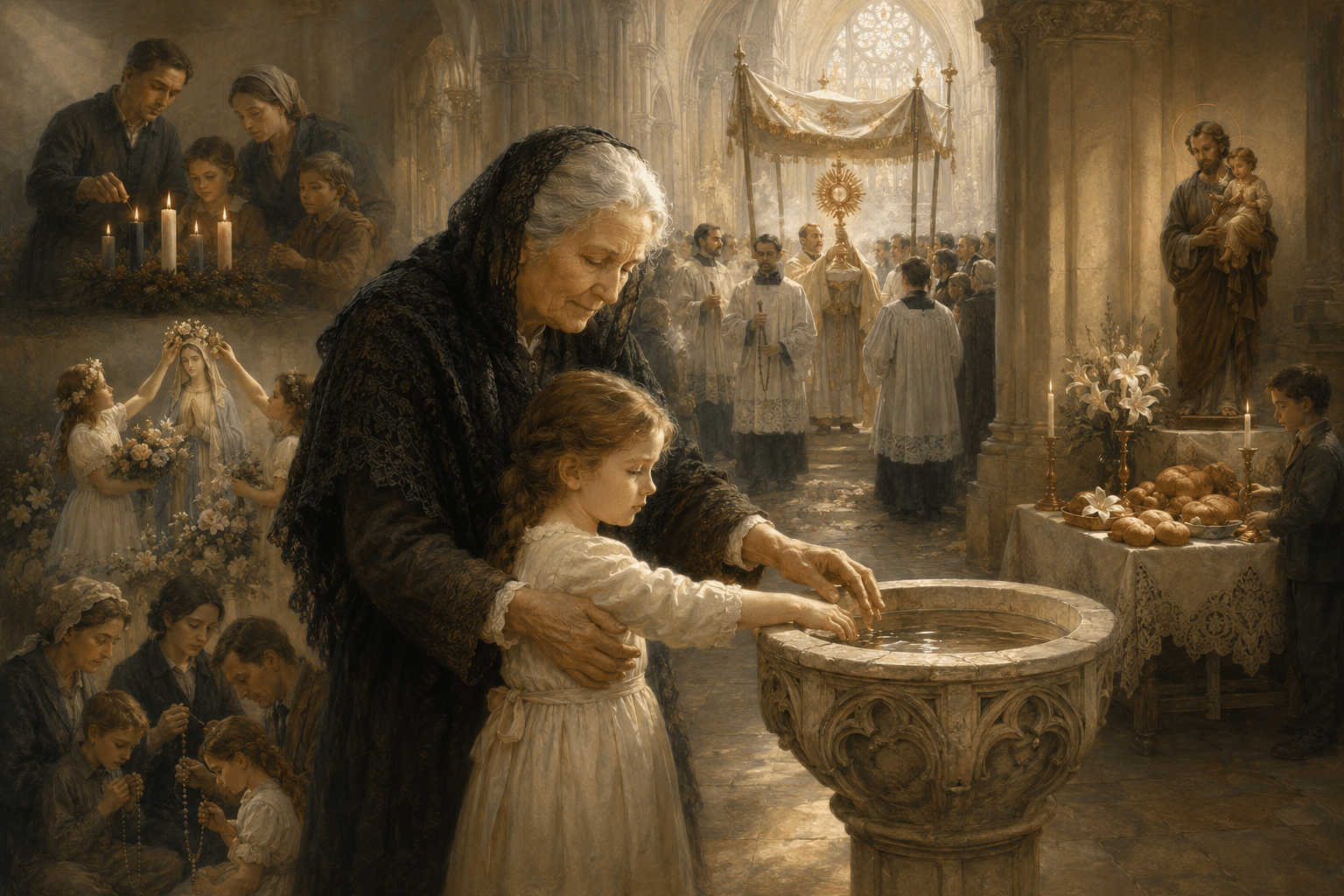
A child watches his grandmother enter a church and reach toward the holy water. She touches her forehead, her chest, one shoulder, and then the other as she makes the Sign of the Cross. The child imitates her without asking why. No formal lesson begins, and nobody opens a catechism. Many years later, after the grandmother has died and the child has grown into an adult, he enters another church in another town. Almost instinctively, his hand reaches toward the holy water, and he makes the same ancient sign that he once learned by watching her. Catholic traditions often travel through time in just this way, passing quietly from hand to hand, home to home, and generation to generation.
Catholic life holds an extraordinary treasury of such traditions. Families light Advent wreaths, arrange Nativity scenes, pray the Rosary, walk the Stations of the Cross, crown statues of Mary with flowers, prepare Saint Joseph Tables, bless their homes at Epiphany, wear sacred medals and scapulars, make pilgrimages, pray novenas, light devotional candles, and celebrate the feast days of beloved saints. Catholic communities across the world have developed thousands of customs over nearly two thousand years, and many of those customs still survive because one person cared enough to teach another.
What Are Catholic Traditions?
Catholic traditions include the customs, prayers, devotions, feast-day observances, family practices, foods, pilgrimages, sacred objects, and seasonal rituals that have grown around Catholic life. Some traditions belong broadly to Catholics throughout the world, while others developed within particular countries, regions, religious communities, parishes, or families. An Italian Catholic family may observe a feast differently from a Mexican, Polish, Filipino, Irish, or Lebanese Catholic family, yet each family can use those customs to express and deepen the same Catholic Faith.
When discussing these customs, Catholics should distinguish them from Sacred Tradition in the theological sense. Sacred Tradition, together with Sacred Scripture, transmits the apostolic Faith entrusted to the Church. A family’s custom of preparing a special bread for Saint Joseph’s Day belongs to a different category. Catholics may adopt, change, or discontinue many devotional and cultural customs without changing the Faith itself. Even so, these smaller traditions matter because they give Catholic belief a place within the rhythms of ordinary human life.
Why Catholic Traditions Use Physical Things
Catholicism has always understood the importance of the physical world. Water cleanses in Baptism. Oil anoints. Incense rises during worship. Candles burn beside altars and sacred images. Ashes mark foreheads at the beginning of Lent, while blessed palms enter churches on Palm Sunday. Bells call communities to prayer, and bread and wine stand at the heart of the Eucharistic liturgy. Catholic devotional traditions follow this same incarnational pattern by joining prayer to things that people can see, hear, touch, carry, and remember.
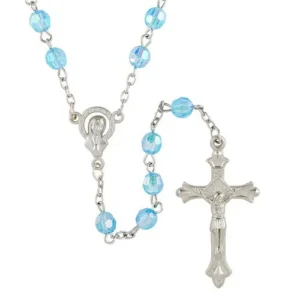
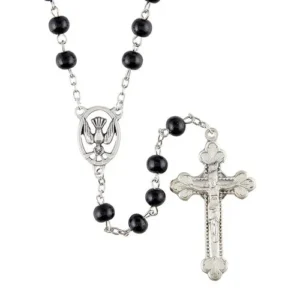
A person praying the Rosary moves beads through the fingers while meditating upon the mysteries of Christ. A Catholic wears a medal that recalls a saint’s example and intercession. A family hangs a crucifix where children will see it every day, while another lights a candle beside a sacred image during evening prayer. These objects do not possess meaning merely because people own them. They acquire their devotional significance through the faith, prayer, and remembrance toward which they direct the person who uses them.
Human beings naturally remember through their senses and through repeated actions. A familiar prayer can recall the voice of the parent who first taught it, while the scent of incense can awaken memories of Masses celebrated decades earlier. Rosary beads worn smooth by years of prayer can carry memories that newer objects cannot yet possess. Catholic traditions draw upon this deeply human capacity for memory and allow the Faith to take root not only in the intellect but also within the habits of daily life.
Advent Traditions: Learning How to Wait
The Church’s liturgical year gives Catholic families a natural rhythm for many of these traditions, and Advent offers one of the clearest examples. Advent teaches Christians to wait for the coming of Christ, and Catholic customs make that waiting visible within the home. Families light one candle on the Advent wreath during the first week, then another as each Sunday passes. A Nativity scene may gradually take shape, while some families leave the manger empty until Christmas so that the absence of the Christ Child quietly expresses the expectation of the season.
Other Advent customs deepen that sense of preparation. Families may celebrate Saint Nicholas Day, pray the ancient O Antiphons during the final days before Christmas, read Scripture together, perform acts of charity, or follow an Advent calendar that directs attention toward the Nativity rather than simply counting down to presents. These practices teach something that the surrounding culture can easily obscure: Christians do not need to consume Christmas before it arrives. Advent gives families permission to wait, prepare, and allow expectation to grow.
Christmas Traditions: Letting the Celebration Linger
When Advent finally gives way to Christmas, Catholic tradition encourages families to celebrate rather than immediately move on. The commercial Christmas season may begin disappearing from stores almost as soon as December 25 passes, but the Church continues to celebrate the mystery of the Incarnation. Families can reflect that longer rhythm by keeping the Nativity scene in place, continuing Christmas prayers and hymns, celebrating important feast days, and allowing the joy of Christ’s birth to remain present in the home.
The celebration also extends naturally toward Epiphany, when many Catholic cultures preserve traditions connected with the visit of the Magi. Families may bless their homes, prepare special foods, gather for prayer, or follow customs inherited from the countries and communities of earlier generations. Such practices give Catholic families an opportunity to resist the constant pressure to rush toward whatever comes next and instead remain for a while with the mystery the Church continues to celebrate.
Lenten Traditions: Making Repentance Visible
Lent changes the rhythm again. Where Christmas celebrates abundance and joy, Lent strips away distractions and calls Christians toward prayer, fasting, almsgiving, and repentance. Ashes mark the beginning of the season, the Alleluia disappears from the liturgy, and Catholics simplify certain parts of daily life as they prepare for the Passion, Death, and Resurrection of Christ.
Families can bring that Lenten character into the home in many ways. They may eat simpler meals, reduce entertainment, give more generously to people in need, pray together more regularly, or attend the Stations of the Cross on Friday evenings. Parents may help children choose sacrifices that carry genuine meaning rather than treating Lent as a contest in giving up sweets. Through these practices, repentance moves beyond an abstract idea and enters the daily choices of family life.
The physical character of Lenten traditions also teaches an important lesson. What people love, surrender, eat, buy, watch, and do with their time shapes the spiritual life. A Friday meal without meat will not by itself make someone holy, but a deliberate act of abstinence can interrupt an ordinary routine and turn the mind toward Christ. Catholic tradition often works through such small interruptions because they create moments in which the soul can remember what the ordinary pace of life encourages it to forget.
Marian Traditions: Walking Toward Christ with Mary
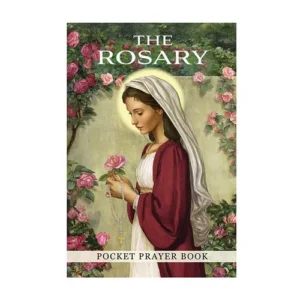
Among Catholic devotional practices, Marian traditions form one of the richest and most enduring treasuries. Catholics pray the Rosary, hold May crownings, place flowers before images of the Blessed Virgin Mary, wear the Brown Scapular and Miraculous Medal, observe October as a month particularly associated with the Rosary, and make pilgrimages to Marian shrines. The Church also celebrates numerous Marian feast days and titles, including Our Lady of Guadalupe, Our Lady of Lourdes, Our Lady of Fatima, and Our Lady of Mount Carmel.
Properly understood, these devotions never place Mary in competition with Christ. Mary directs the faithful toward her Son, just as she does throughout the Gospel. Marian devotion therefore invites Catholics to contemplate Christ with the woman who carried Him, raised Him, followed Him, stood beneath His Cross, and remained with His disciples in prayer. Whether a family gathers for the Rosary or a parish crowns an image of Mary during May, authentic Marian devotion ultimately leads beyond the outward practice toward a deeper relationship with Jesus Christ.
Marian customs also demonstrate how easily Catholic traditions can pass from one generation to another. A mother may teach her children the Hail Mary at bedtime, while grandparents may gather grandchildren around a Rosary during a difficult season. A child may first encounter Marian devotion through flowers placed before a statue in May and understand its theological meaning only years later. The practice plants a memory, and understanding often grows around that memory with time.
Saint Feast Days: Remembering Lives Worth Imitating
The feast days of the saints give Catholic families another way to bring the Church’s history into ordinary life. The liturgical calendar fills the year with men and women who followed Christ in different centuries, countries, circumstances, and vocations. Their feast days allow Catholics to remember that holiness does not belong only to an unreachable past. Real people lived the Christian life under real pressures, and the Church continues to hold their lives before us as examples.
Many saints have inspired distinctive customs. Catholics often associate Saint Francis of Assisi with blessings of animals, while Saint Joseph inspires tables filled with breads and foods that families share with others. Traditions surrounding Saint Nicholas emphasize generosity and gift giving, and celebrations of Saint Patrick can recall the remarkable life of the missionary bishop who helped spread Christianity in Ireland. When families recover the Christian meaning behind these feast days, familiar celebrations can become opportunities for prayer, generosity, storytelling, and learning.
Families can also make patron saints part of everyday Catholic life without creating elaborate celebrations. Parents might tell the story of a child’s patron saint at dinner, attend Mass on a special feast day when possible, prepare a favorite family food, read a short biography, or ask the saint’s intercession during evening prayers. Through these simple habits, children begin to encounter the communion of saints not merely as a doctrine they study but as part of the living family of the Church.
How Children Learn Catholic Traditions
Children often remember Catholic customs long before they understand the theology behind them. A young child may not understand the full meaning of Advent, but she notices when the family lights another candle on Sunday. A boy may know little about the communion of saints, yet he remembers the medal his grandfather gave him. A child walking the Stations of the Cross may understand only part of Christ’s Passion, but he remembers moving quietly from station to station beside his parents on a Friday evening during Lent.
As children grow, understanding can catch up with memory. The Advent wreath that once meant another candle now becomes a lesson in expectation. The medal from a grandfather opens a conversation about a saint’s life. The Stations of the Cross become more than a familiar Friday practice as an older child begins to understand sacrifice, suffering, and redemption. Catholic traditions often teach effectively because they allow families to plant memory first and deepen understanding over time.
Parents and grandparents therefore teach the Faith in ways that reach beyond formal religious instruction. Children notice whether adults bless themselves before meals, stop at a church while traveling, pray for someone who has died, keep a crucifix in the home, or speak naturally about a patron saint. They learn not only from what adults explain but also from what adults repeatedly do. When Catholic practices become part of family life, children encounter the Faith as something lived rather than something reserved for a classroom or Sunday morning.
Recovering Catholic Family Traditions
Many Catholic customs have faded because families simply stopped passing them forward. Immigration and assimilation sometimes separated families from the religious customs of their homelands, while busy schedules and changing patterns of parish life weakened other traditions. In some families, an older relative knew a prayer that nobody thought to write down. A grandfather observed a feast day every year, but the grandchildren never asked why. Once one generation stopped practicing a custom, the next generation often inherited little more than a vague memory of it.
Families can recover these traditions, however, without pretending to live in another century. They might begin by celebrating the feast days of patron saints, blessing the home, observing Advent before rushing into Christmas, praying for the faithful departed during November, making a pilgrimage to a Catholic shrine, visiting a cemetery to pray for deceased relatives, preparing a traditional feast-day meal, or rediscovering an old novena. Families with roots in particular countries can also explore the Catholic customs their ancestors may once have practiced.
The goal does not require a family to adopt every tradition it discovers. Too many new practices can turn devotion into another crowded schedule. A family can instead choose a few customs that fit naturally within its life and practice them faithfully enough for children to remember them. One Advent wreath used every year, one patronal feast celebrated faithfully, or one family Rosary prayed regularly can shape memory more deeply than dozens of practices attempted once and quickly abandoned.
Sacred Objects and the Memory of Faith
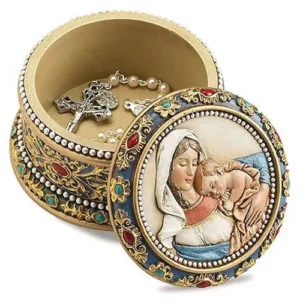
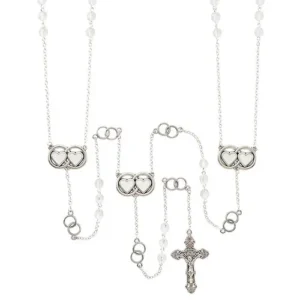
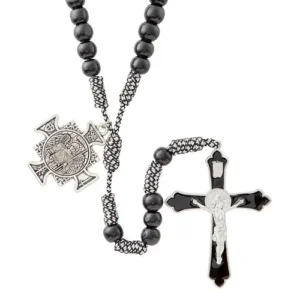
Religious objects often become part of this transmission because families use them repeatedly within prayer and devotion. A Rosary may pass from a grandmother to her daughter and eventually to a grandchild. A crucifix may hang in several family homes over the course of decades. A saint medal, devotional candle, holy card, Bible, scapular, or sacred image may begin as an ordinary religious object and gradually acquire a history through the prayers and people connected with it.
The object itself never replaces the devotion it serves. A Rosary matters because someone prays it. A medal matters because it recalls the saint whose example and intercession direct the wearer toward Christ. A devotional candle matters because someone lights it in prayer. A sacred image matters because it turns the mind toward the holy person or mystery it depicts. Catholic tradition loses something essential whenever the outward object becomes detached from its spiritual purpose.
At the same time, Catholics need not dismiss the importance of these physical reminders simply because the object does not possess value by itself. Human beings attach memories to things, and religious objects can carry those memories across generations. A worn Rosary may recall the hands that once held it, while a faded holy card can preserve the memory of a funeral, First Communion, or pilgrimage. A crucifix hanging above a doorway can silently connect the family that lives beneath it with the faith of those who placed it there years before.
Keeping Catholic Traditions Alive
Families preserve Catholic traditions most successfully when they allow the practices to lead somewhere deeper. The Advent wreath should prepare the family for Christ’s coming. The Lenten sacrifice should encourage conversion. The saint’s feast should inspire imitation of Christian virtue. The Marian devotion should draw the heart toward Jesus. The pilgrimage should express an interior journey toward God. When families understand the purpose behind a custom, they can adapt its outward form to changing circumstances without losing the spiritual truth that gave the tradition life.
This understanding also protects Catholic traditions from becoming mere nostalgia. A family may treasure the way a grandmother celebrated a feast day, but the purpose of remembering her custom does not lie simply in recreating the past. The family keeps the tradition alive when a new generation receives its meaning and makes room for it within the present. Living tradition always involves both memory and renewal because each generation receives something it did not invent and then accepts responsibility for carrying it forward.
That responsibility often rests upon very small things. A mother teaches her daughter a prayer before bed. A father makes the Sign of the Cross before a meal, and a toddler copies him. A family lights the Advent wreath again when December returns. Someone places flowers before an image of Mary in May, carries a Rosary in a pocket, prepares a meal for a saint’s feast, or visits the cemetery in November to pray for grandparents who once stood beside the same family table.
Years later, the children who watched those customs may find themselves repeating them in homes of their own. They may not remember the first time they saw someone reach toward holy water or taught them a particular prayer, and they may never know which ancestor first brought a beloved Catholic custom into their family. Yet the practice remains because someone received it, lived it, and passed it onward. In that quiet movement from one generation to another, Catholic tradition does more than preserve the memory of the past; it helps the Faith take root in the present and gives the next generation something living to carry into the future.