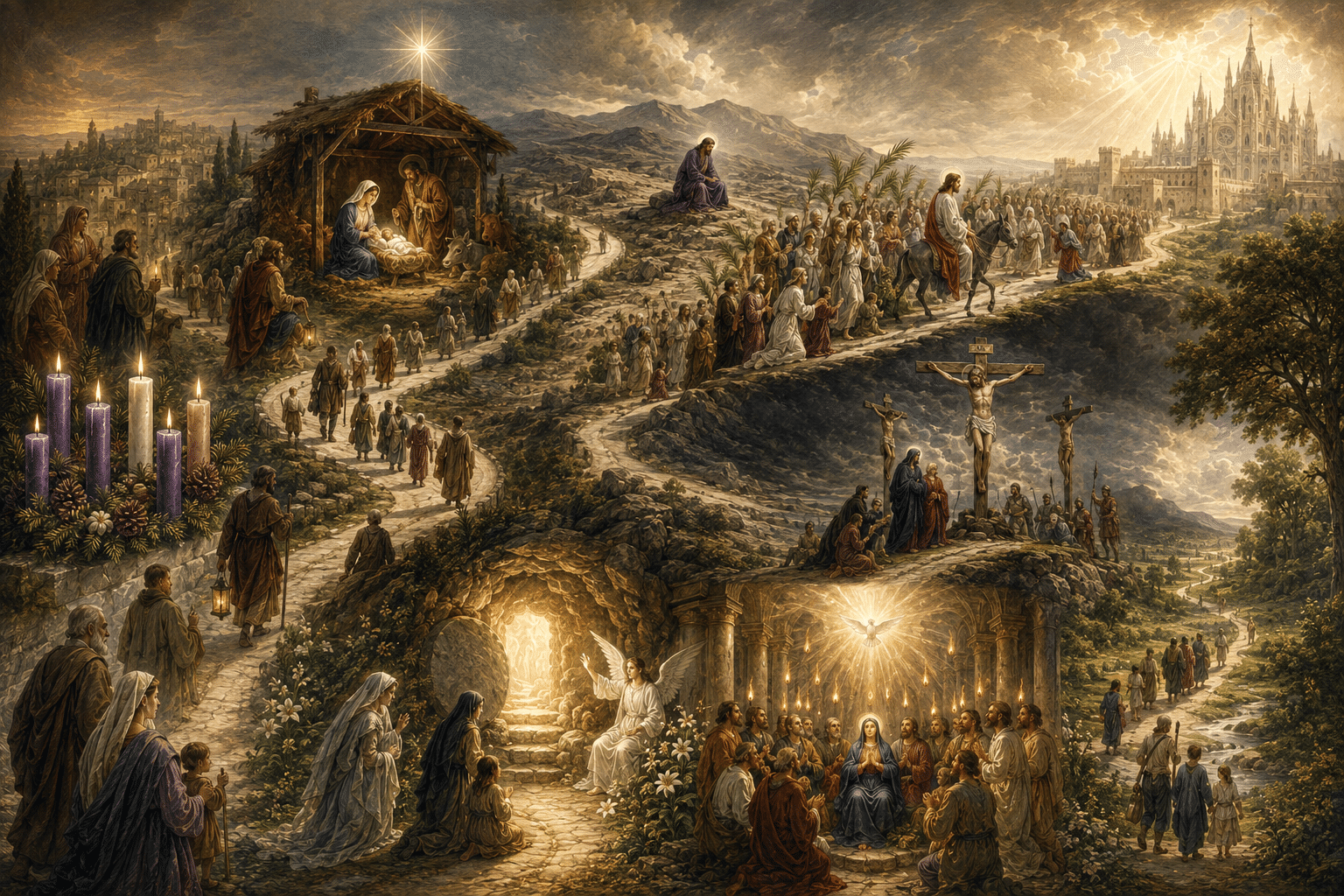
The Church does not simply count the days. She gives them meaning. Each year she waits again for Christ. Bethlehem returns. The desert opens before us. Christ enters Jerusalem, carries the Cross, and rises from the tomb. At Pentecost, the Holy Spirit descends in fire. Then the Church enters the long green weeks of Ordinary Time.
Catholics know these stories. Many have heard them since childhood. Yet the Church deliberately tells them again because we never return to them as the same people. Another year has passed. We have known new joys, carried new sorrows, committed new sins, received new graces, and perhaps learned truths we could not understand the year before.
Through this recurring journey, the Catholic liturgical year leads the faithful through the life, death, Resurrection, and saving mission of Jesus Christ. Throughout the year, the Church also honors the Blessed Virgin Mary, the Apostles, martyrs, angels, and saints who followed Christ before us. Advent, Christmas, Lent, the Paschal Triduum, Easter, and Ordinary Time give the year its rhythm. Together, these seasons teach us when to wait, when to rejoice, when to repent, and when to persevere in the ordinary work of following Christ.
Advent: Learning to Wait
That journey begins quietly with Advent. By then, the world around us may already rush toward Christmas. Stores hang decorations. Christmas music fills the air. Packages arrive at doorsteps. Calendars fill with parties and obligations. Against all this hurry, the Church chooses another path. She waits. For four weeks, candles measure the passing Sundays. The prophets speak again through Scripture. John the Baptist calls from the wilderness. Mary journeys toward Bethlehem. In this way, Advent fills the weeks with expectation but refuses to hurry them. The season reminds us of something modern life encourages us to forget: some good things require waiting. Even the colors of the season reinforce that lesson. Violet clothes the Church during much of Advent and calls the faithful toward preparation and penitential expectation. On Gaudete Sunday, the third Sunday of Advent, rose may replace violet and announce that Christmas draws near. Before the priest speaks a word, the colors tell us that the season has changed.
Christmas: God Comes Near
At last, Christmas arrives, and waiting gives way to joy. At the center of the Nativity stands a truth so familiar that we can easily overlook its wonder: God entered human history as a child. He did not arrive as an emperor leading an army or as a wealthy man surrounded by servants. Instead, He entered the poverty and vulnerability of ordinary human life. Mary held Him. Joseph protected Him. Shepherds left their fields to find Him. The One through whom God created all things became small enough for human arms to carry.
Because the mystery reaches far beyond a single day, the Catholic celebration of Christmas continues beyond December 25. The Church remains with the mystery of the Incarnation, while white and gold fill the liturgy with signs of joy and glory. The wider culture may pack away Christmas almost as quickly as it arrived. The Church lingers at Bethlehem. Some mysteries deserve more than a day.
Ordinary Time: The Quiet Work of Faith
Eventually, the Christmas season gives way to the first period of Ordinary Time. The name sometimes causes confusion because “ordinary” can sound unimportant. It means nothing of the sort. The word refers to the ordered numbering of the weeks.
As green fills the sanctuary, the Gospel turns our attention toward Christ’s public ministry and the steady work of discipleship. The Church gives us fewer dramatic changes during these weeks, and that simplicity teaches its own lesson. Most Christians live much of their faith when no great feast approaches and no extraordinary moment carries them forward. So we pray. We attend Mass. We forgive someone again. We care for our families. We resist an old temptation. We try to become more patient. Inevitably, we fail at some of these things. Then we ask forgiveness and begin again. God builds much of the Christian life from such ordinary things.
Lent: Remembering What Matters
But the green weeks do not continue forever. Ash Wednesday comes, and Lent begins with dust. The ashes confront us with the brevity of human life. Yet Lent does not remind us of death to drive us toward despair. It reminds us because mortality clarifies what matters.
For forty days, Catholics prepare for Easter through prayer, fasting, and almsgiving. Violet returns. The liturgy grows quieter and more restrained. The Church sets aside the Alleluia until Easter. Gradually, the outward simplicity of the season invites an inward examination. Lent asks us to look at ourselves without excuses. We recognize habits that control too much of our lives, sins we have learned to justify, prayers we have neglected, and people we have failed to love well. Repentance begins when we stop hiding these things from ourselves and bring them before God.
Even here, however, the Church does not leave us without hope. Christian repentance never ends in hopelessness. We open our hands so God can fill them. Lent always travels toward Easter. Even when the priest places ashes upon our foreheads, the empty tomb waits at the end of the road.
Holy Week and the Road to Calvary
As Lent draws to its close, the Church enters Holy Week. On Palm Sunday, Catholics remember Christ’s entrance into Jerusalem. The faithful carry palms, hear the Passion proclaimed, and encounter joy and sorrow within the same liturgy. From there, the road narrows. Christ gathers His disciples in the upper room. He enters Gethsemane. Judas betrays Him. Authorities condemn Him. He carries the Cross toward Calvary. What began with ashes now approaches the mystery at the center of Christian faith: Christ gives His life for the world. For this reason, the Church does not observe Holy Week as though she merely commemorates distant history. The liturgy draws Catholics into these events. We listen again. We watch again. We stand again at the foot of the Cross because what happened there continues to shape every Christian life.
The Paschal Triduum: From Darkness to Light
Within Holy Week, the Paschal Triduum forms the heart of the Catholic liturgical year. On Holy Thursday, the Church returns to the Last Supper and Christ’s institution of the Eucharist. On Good Friday, she follows Him to the Cross. On Holy Saturday, the tabernacle stands empty while the Church waits in silence. Then, after that long silence, the Easter Vigil begins. A fire breaks the darkness. The priest lights the Paschal candle, and its flame passes from one person to another. Scripture unfolds the great story of salvation. The Church blesses water. Finally, the Alleluia, silent throughout Lent, sounds again. Few images capture the Christian faith so simply: one flame enters a dark church and spreads until darkness can no longer overcome it.
Easter: The Great Season of Joy
With that light, Easter begins. Yet Easter Sunday does not end the Easter season. The Church celebrates the Resurrection for fifty days and carries its joy all the way to Pentecost. Now white and gold return. Flowers fill the sanctuary. The Alleluia rings out again. After the restraint of Lent and the sorrow of Good Friday, the Church proclaims the truth on which Christianity stands: death did not win.
Even the disciples needed time to understand what had happened. They found the tomb empty, encountered the risen Christ, and slowly learned how to live in a world transformed by the Resurrection. In a sense, Christians continue learning that same lesson. Easter, therefore, does not merely finish the story. Easter begins a new one.
Pentecost: Sent Into the World
Fifty days later, Pentecost brings red, fire, and mission. The Holy Spirit descends upon the Apostles and transforms frightened men who once hid behind locked doors into witnesses who carry the Gospel into the world. Seen from this point in the year, the journey that began in Advent reveals its direction. The Church waited during Advent, rejoiced at Christmas, followed Christ through His ministry, repented during Lent, stood beneath the Cross, and celebrated the Resurrection. But Christ does not call His Church merely to remain at the empty tomb. He sends her into the world. In much the same way, the Christian life moves outward. God gives faith to each person intimately, but He never intends us to keep that faith locked within ourselves. We carry what we receive into our homes, workplaces, parishes, friendships, communities, and encounters with the people God places before us.
Ordinary Time and the Slow Growth of Holiness
Once Pentecost passes, the Church enters the long stretch of Ordinary Time, and green spreads across the calendar again. After so many great feasts and dramatic mysteries, the return to ordinary weeks can seem almost uneventful. Yet perhaps no season resembles everyday Christian life more closely.
Most growth happens quietly. A seed disappears beneath the soil before a green shoot breaks the surface. Children grow a little each day, though no parent can identify the precise moment when childhood gives way to maturity. Friendships deepen through years of conversation, sacrifice, forgiveness, and kindness.
Faith grows much the same way. For that reason, one heroic moment rarely builds a holy life. Ordinary prayers, small sacrifices, Sunday Masses, works of mercy, acts of forgiveness, and daily choices form us over years. We fall and rise. We wander and return. We pray when prayer feels fruitful and continue praying when it does not. Through it all, the Christian keeps showing up. The Christian keeps beginning again. Grace works patiently.
What the Catholic Liturgical Colors Mean
As the seasons change, the Church makes their meaning visible through color. White and gold proclaim joy and glory and accompany many celebrations of the Lord, the Blessed Virgin Mary, angels, and saints who did not die as martyrs. Red recalls fire, blood, sacrifice, and the Holy Spirit, and the Church uses it for Pentecost, celebrations of the Lord’s Passion, and the feasts of martyrs.
Meanwhile, green marks Ordinary Time and suggests life and growth. Violet calls the faithful toward preparation and penance, especially during Advent and Lent. Twice each year, rose may interrupt the violet—on Gaudete Sunday during Advent and Laetare Sunday during Lent—to signal approaching joy.
These colors do more than decorate a church. They quietly teach. A young child may not yet understand the structure of the liturgical calendar, but the child can notice that the priest wears a different color. Over the years, those colors become familiar. Green means one thing. Violet signals another. White announces joy. Red catches the eye and tells us to pay attention. In this way, the Church teaches the eyes along with the ears.
Bringing the Liturgical Year Into the Catholic Home
What Catholics encounter at Mass can also continue beyond the church doors. Families can carry the rhythm of the liturgical year into their homes and allow its seasons to shape everyday life.
During Advent, a wreath can measure the weeks before Christmas. A family can build the Nativity scene gradually as Bethlehem draws near. When Lent arrives, simpler meals, greater generosity, and more deliberate prayer can reflect the character of the season. Families can pray the Stations of the Cross together. Then, when Easter comes, they can celebrate it as a season rather than allowing the celebration to end after Easter Sunday Mass and brunch.
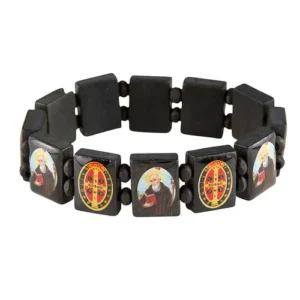
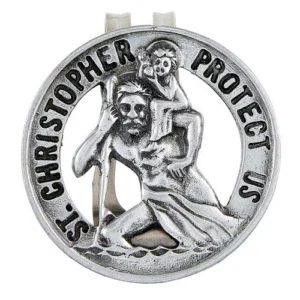
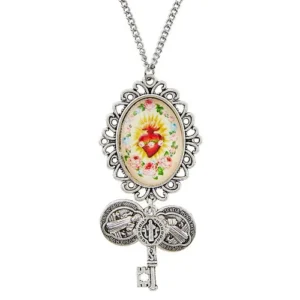
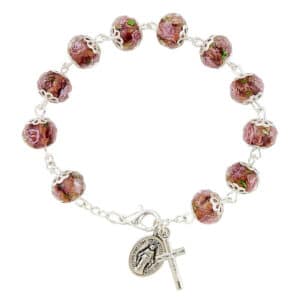
The same rhythm can continue throughout the year. Families can mark a favorite saint’s feast day with a special meal. Parents can teach children why the priest changes vestment colors, why Catholics stop singing the Alleluia during Lent, and why familiar prayers and customs return at particular times each year. None of this requires elaborate preparation. A candle can mark a feast. A crucifix can draw the family’s attention toward Christ. A saint’s image can begin a conversation. A Rosary can gather a family together for prayer. Little by little, the Catholic home begins to keep time with the Church.
Sacred Time Changes the Question
Once that rhythm becomes familiar, the calendar itself begins to ask different questions. The ordinary calendar asks something practical: What day is it? The liturgical calendar asks deeper questions. Are we waiting? Are we rejoicing? Do we need to repent? Where do we need to grow? What must we surrender? Where does God ask us to persevere? Where does He send us next?
The Church returns to the same seasons precisely because human beings need to return to the same truths. We forget. We become distracted. Life changes around us. We carry new burdens into familiar seasons, and those burdens can change what we hear.
For example, one Easter may find us joyful. Another may find us grieving someone who sat beside us the year before. One Advent may fill the house with the noise of young children. Years later, Advent may come to the same house after those children have grown and left home. Likewise, a prayer we have heard a hundred times may suddenly speak directly to a sorrow we did not carry the first ninety-nine times.
So the Church repeats the story, but the repetition never leaves us exactly where it found us. The story remains. We change. Year after year, the Church leads us through Advent, Christmas, Lent, Easter, and Ordinary Time. She carries the same Gospel into lives that never stop changing. We wait again. We rejoice again. We repent again. We grow. We fail. We return. And once again, we stand before the empty tomb and hear the news that changed the world. Then the year turns. Advent approaches. And the Church begins telling us the story again.